Dog Diarrhoea Natural Remedies UK: 6 That Actually Help Firm Up Stools

The six natural steps that reliably help a UK dog with acute diarrhoea are: a short 12 to 24 hour rest period from food (adult dogs only, not puppies), a bland cooked rice and chicken diet for 2 to 4 days, a UK-approved kaolin, bentonite or attapulgite gut binder to firm stools within hours, a multi-strain probiotic with prebiotic to shorten diarrhoea duration by 1 to 3 days, plentiful water plus electrolyte support to avoid dehydration, and a slow food reintroduction over 5 to 7 days. Skip loperamide (Imodium) unless your vet has specifically prescribed it, and skip raw meat or dairy while your dog is unwell.
Around 15 to 20% of UK dogs will have at least one episode of acute diarrhoea in any given year, and it is the third most common reason owners contact a vet. This guide is for adult dogs having a short bout that is not accompanied by red-flag symptoms. Puppies, seniors, small breeds and any dog with vomiting alongside diarrhoea need a much lower threshold for calling the vet.
Key Takeaway
Most adult dogs with a single-day bout of loose stools respond well to a bland diet, a UK-approved gut binder liquid and a course of multi-strain probiotics. Ring your vet the same day if there is blood, black tarry stool, repeated vomiting, a very young or very old dog, or diarrhoea that lasts beyond 48 hours.
In this article
- What Causes Dog Diarrhoea in the First Place?
- When Should You Ring the Vet Straight Away?
- Should You Fast Your Dog with Diarrhoea?
- What Is the Best Bland Diet for a Dog with Diarrhoea?
- Do Probiotics Actually Help Dogs with Diarrhoea?
- What About Kaolin, Bentonite and Digestive Clays?
- Should You Give Your Dog Loperamide (Imodium)?
- Do Slippery Elm and Pumpkin Actually Work?
- How Do You Keep a Dog with Diarrhoea Hydrated?
- How Long Should Diarrhoea Last Before You Worry?
- How Do You Prevent Diarrhoea Coming Back?
- Frequently asked questions
What Causes Dog Diarrhoea in the First Place?
UK vets group diarrhoea into two big buckets. Acute diarrhoea lasts under 14 days and is usually a dietary indiscretion (bin-raiding, sudden food change, human food scraps, a stolen sandwich in the park). Chronic diarrhoea lasts more than 14 days and points at food allergy, inflammatory bowel disease, endocrine disease or parasites.
The most common triggers a UK dog owner will meet in real life are new food, a change in the treat rotation, a picked-up snack on the daily walk, stress (kennel stays, moves, fireworks), antibiotic courses and mild viral bugs. Almost all of these resolve inside 48 to 72 hours with sensible management.
Chronic causes need veterinary work-up. If your dog has three or more separate loose-stool bouts in a month, or the stools are consistently soft rather than firm, book an appointment for a faecal panel and a diet review rather than reaching for another calming supplement.
When Should You Ring the Vet Straight Away?
Worth Knowing
Ring your vet the same day (or use the out-of-hours service) if any of these apply: your dog is a puppy under 6 months, a senior over 10, a small or toy breed, is vomiting alongside diarrhoea, the stool contains fresh red blood or looks black and tarry, the dog is lethargic or unresponsive, is refusing water, has pale or tacky gums, has a bloated abdomen, or the diarrhoea has already run beyond 48 hours. These signs can point at parvovirus, pancreatitis, gastric dilatation or an obstruction, and none of them wait.
Puppies dehydrate dangerously fast. A puppy that loses fluid overnight can be in trouble by morning, so the threshold to call a vet is much lower for a dog under 6 months than for a 5 year old Labrador with one loose stool.
NHS-style triage does not exist for pets in the UK, but the PDSA runs an excellent free dog diarrhoea guide that mirrors most vet triage protocols. When in doubt, ring your practice and let the receptionist decide whether it needs same-day attention.
Should You Fast Your Dog with Diarrhoea?
The old advice was 24 hour fasting for any adult dog with diarrhoea. Current UK veterinary consensus is softer: a 12 hour rest from food is enough for most adult dogs, and outright fasting is not appropriate for puppies, toy breeds, seniors or thin dogs.
The reason to give the gut a short rest is simple. Food in a stressed gut means more work for a system that needs a moment to reset. Twelve hours of only-water lets the gut lining calm, then the bland diet gently restarts digestion.
Never fast a puppy for more than 4 to 6 hours. Their glucose stores are small and hypoglycaemia comes on quickly. If a puppy has diarrhoea, the plan is fluids and a small bland meal, not a fast.
What Is the Best Bland Diet for a Dog with Diarrhoea?
The UK vet-standard bland diet is plain white rice with skinless boiled chicken breast in a 2 to 1 ratio by cooked weight. Feed small portions four to six times a day rather than two big meals, which reduces gut load and helps stool firm up faster.
Vegetarian, plant-based or chicken-allergic dogs can use plain white rice with plain scrambled egg (no oil, no butter), plain low-fat cottage cheese, or plain white fish. Avoid raw meat, fatty cuts, gravy, herbs, garlic, onion or dairy while the dog is unwell.
| Dog weight | Bland meal size | Frequency |
|---|---|---|
| Up to 10kg | 2 to 3 tablespoons | Every 4 to 5 hours |
| 10 to 25kg | Half a mug | 4 to 5 times a day |
| 25 to 40kg | 1 mug | 4 to 5 times a day |
| Over 40kg | 1.5 to 2 mugs | 4 to 5 times a day |
Keep the bland diet running for 2 to 4 days after the stool firms up, then reintroduce their normal food gradually. Mix 25% normal food with 75% bland on day 1 of reintroduction, then 50/50, then 75% normal, then full normal over 4 days. Rushing the switch is the most common cause of a second bout.
Do Probiotics Actually Help Dogs with Diarrhoea?
The strongest evidence for a supplement in acute dog diarrhoea is for multi-strain probiotics with a prebiotic. Two of the most cited trials found that dogs given a probiotic recovered from acute gastroenteritis 1 to 3 days faster than dogs on standard bland-diet care alone.
What the Research Says
Herstad et al. 2010 in Journal of Small Animal Practice (DOI: 10.1111/j.1748-5827.2010.00902.x) gave 36 dogs with acute idiopathic gastroenteritis either a multi-strain probiotic or a placebo alongside standard care. The probiotic group reached normal stool consistency in 1.3 days on average vs 2.2 days in the placebo group, a 40% reduction in symptom time. Bybee, Scorza and Lappin 2011 (J Vet Intern Med, DOI: 10.1111/j.1939-1676.2011.0793.x) showed the probiotic Enterococcus faecium SF68 also reduced diarrhoea prevalence in shelter dogs.
The trial-relevant profile is 1 to 5 billion CFU per day, delivered as multiple strains rather than a single strain, with a prebiotic like fructooligosaccharides (FOS) or inulin to feed the good bacteria you have just added. Single-strain human probiotics tend to underperform because dog and human gut microbiomes are different.
Our Probiotics for Dogs tablets deliver 2 billion CFU per tablet from a five-strain blend (L. acidophilus, L. brevis, L. rhamnosus, L. plantarum and B. lactis) with inulin prebiotic and a 6-enzyme digestive complex. Feed for at least 10 to 14 days after the diarrhoea has resolved to help re-establish the microbiome.
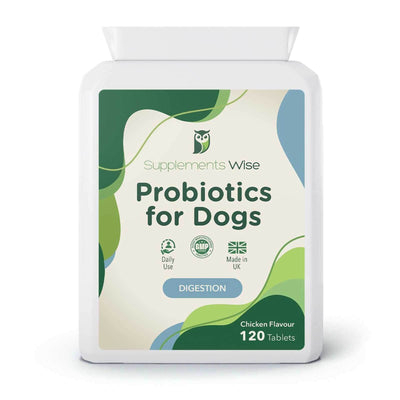
Probiotics for Dogs 120 Tablets
5 strains, 2 billion CFU per tablet, with inulin prebiotic and 6 digestive enzymes. Chicken-flavour.
UK GMP-certified · 30-day returns · Free UK shipping
£19.95
Add to CartWhat About Kaolin, Bentonite and Digestive Clays?
Digestive clays are the fastest-acting home tool for firming up a dog's stool. Bentonite, montmorillonite, attapulgite and kaolin are all natural mineral clays that bind toxins, absorb excess water in the gut and coat the gut lining. Owners often see a firmer stool within 12 to 24 hours of the first dose.
These are the ingredients behind most vet-shelf products like Pro-Kolin, Canikur and Diafarm. Our Tummy Relief for Dogs uses the same evidence-graded blend (166,900mg bentonite plus montmorillonite and activated attapulgite per 250ml bottle) with carboxymethylcellulose to soothe the gut lining, delivered as a chicken-flavoured liquid via a dosing syringe.
Weight-based dosing is 5ml for dogs up to 10kg, 10ml for 10 to 25kg, 15ml for 25 to 40kg and 20ml for over 40kg, given twice daily on day 1 then once daily until the stool is firm for 24 hours. Safe from around 6 weeks old.

UK GMP liquid with bentonite, montmorillonite and attapulgite. Included dosing syringe.
UK GMP-certified · Puppy-safe from 6 weeks · 30-day returns · Free UK shipping
£22.95
Add to CartGive the gut binder at least 2 hours away from probiotics or other medications, since clays can adsorb them too. Space the doses out through the day rather than stacking everything at one meal.
Should You Give Your Dog Loperamide (Imodium)?
Loperamide is a human anti-diarrhoeal that works by slowing gut motility. It is not first-line for dogs in the UK and should only be used when a vet has specifically prescribed it. There are three important reasons.
First, some herding breeds (collies, Australian shepherds, shelties and their crosses) carry the MDR1 gene mutation, which makes loperamide neurotoxic even at safe-for-other-dogs doses. Second, loperamide can worsen diarrhoea caused by infection or a toxin because it traps the offender in the gut. Third, dose is easy to get wrong at home and safe dog doses are much smaller than a human tablet.
If the diarrhoea is severe enough that you are reaching for Imodium, ring the vet instead. They may prescribe a different anti-nausea agent (maropitant), an antibiotic if bacterial, or IV fluids, none of which you can safely improvise at home.
Do Slippery Elm and Pumpkin Actually Work?
Plain cooked pumpkin at 1 to 4 tablespoons mixed into the bland diet adds soluble fibre, which helps firm loose stools and, oddly, also helps mild constipation. The evidence base is thinner than for probiotics but the UK vet consensus is that plain 100% pumpkin (not pumpkin pie filling) is safe and often quietly helpful.
Slippery elm bark powder is the classic herbal soother. A quarter teaspoon per 5kg of body weight, mixed to a slurry with cool water and given 30 minutes before meals, coats the gut lining. Evidence is limited to case reports and traditional use, but it is generally safe and used by many UK holistic vets.
Bone broth, plain cooked porridge and mashed banana are other owner-favourites. None of these will hurt an otherwise-healthy adult dog with mild diarrhoea, but they are supporting cast to the bland diet, gut binder and probiotic. Avoid anything sweetened with xylitol, which is highly toxic to dogs.
How Do You Keep a Dog with Diarrhoea Hydrated?
Fluid loss is the single most dangerous thing about diarrhoea. Keep fresh water available at all times, add a second water bowl in the room your dog uses most, and offer a shallow bowl of unsalted homemade chicken or beef broth (no onion, no garlic, no salt added) if they are reluctant to drink.
Dog-specific electrolyte products (Oralade GI, ProKolin Enterogenic, some Aqueos formulas) are available at UK vet clinics. Human sports drinks like Lucozade Sport are not appropriate for dogs, since the sugar content is too high and the flavourings can worsen gut symptoms.
Check gum moisture as a rough hydration signal. Tacky or dry gums, skin that stays tented when you pinch it above the shoulder blades, or a slow refill of pink colour after pressing on the gum (over 2 seconds) all warrant a vet call.
How Long Should Diarrhoea Last Before You Worry?
A single loose stool with no other symptoms in an otherwise-healthy adult dog is nothing to worry about. 24 to 48 hours of loose stools with a bland diet, gut binder and probiotic on board is a fair window to see improvement.
| Situation | Action |
|---|---|
| Adult dog, single loose stool, bright, eating | Monitor, bland diet next meal, no need to panic. |
| Adult dog, day 1 of loose stools, no other signs | Bland diet, gut binder, probiotic, hydration. |
| Diarrhoea still going at 48 hours | Book a vet appointment for that day. |
| Blood, black tar, vomiting, lethargy, no drinking | Same-day vet, or out-of-hours if evening. |
| Puppy under 6 months, senior over 10, tiny breed | Ring the vet on day 1, do not wait 48 hours. |
| Three or more bouts in a month | Vet work-up for food allergy, IBD or parasites. |
How Do You Prevent Diarrhoea Coming Back?
Most repeat bouts trace back to one of three things: a food change that was too fast, a treat rotation that includes something the dog cannot tolerate, or a walk habit that lets them scavenge from bins and grass. Slow all three of those and repeat episodes become rare.
When switching your dog's food, take at least 7 days to transition. Use 25% new / 75% old for 2 days, then 50/50 for 2 days, then 75/25, then full new. Puppies and dogs with any history of tummy sensitivity often need 10 to 14 days.
Key Takeaway
For dogs that get gut upset every few weeks, a maintenance dose of a multi-strain probiotic plus one high-quality omega source is the two-step foundation. Add a joint or coat supplement only after the gut is settled. See our complete probiotics guide for dogs for how long each supplement takes to work.
For a full-picture stack read our 6 daily essentials for dogs guide and our probiotics timeline article. The Blue Cross diarrhoea guide and the Royal Veterinary College fact file on gastroenteritis are both excellent free UK references worth bookmarking.
Frequently Asked Questions
How do I quickly firm up my dog's diarrhoea at home?
The fastest home combination is a UK-approved kaolin or bentonite gut binder liquid given twice on day 1, a bland rice and chicken diet in small frequent meals, and a multi-strain probiotic. Most adult dogs on this protocol firm up within 24 to 36 hours. Skip loperamide (Imodium) unless a vet has prescribed it.
How long does dog diarrhoea usually last?
Most acute dietary-indiscretion cases resolve in 24 to 72 hours with bland-diet home care. Anything running beyond 48 hours in an adult dog, or any diarrhoea at all in a puppy, senior or tiny breed, warrants a same-day vet call. Chronic diarrhoea (over 14 days) needs a proper work-up.
Can I give my dog human Imodium for diarrhoea?
Only if your vet has specifically prescribed it. Herding breeds carrying the MDR1 gene mutation (collies, shelties, Australian shepherds and crosses) can have severe neurological reactions to loperamide, and it can also trap infections or toxins in the gut. Ring the vet before reaching for the family medicine drawer.
Are probiotics safe for a dog with diarrhoea?
Multi-strain probiotics with a prebiotic are safe for adult dogs and generally shorten diarrhoea by 1 to 3 days. Use a dog-specific product rather than a human capsule, since strains are different. Continue for 10 to 14 days after the stool has firmed up to re-establish the gut microbiome.
Is chicken and rice really the best bland diet for dogs?
Yes, in a 2 parts rice to 1 part boiled skinless chicken breast ratio by cooked weight, fed in small meals four to six times a day. For chicken-allergic dogs, use plain scrambled egg, low-fat cottage cheese or plain white fish with the rice. Avoid oil, salt, garlic, onion or dairy while the dog is unwell.
Should I fast my dog if they have diarrhoea?
A 12 hour rest from food is enough for a healthy adult dog. Never fast a puppy under 6 months, a senior over 10, a toy breed or a thin dog. If in doubt, skip the fast and go straight to the small-meal bland diet with a probiotic.
Can dog diarrhoea be a sign of something serious?
Sometimes. Parvovirus, pancreatitis, gastric dilatation, an obstruction from a swallowed object, poisoning and inflammatory bowel disease can all present with diarrhoea. Red flags are blood, black tarry stool, vomiting, lethargy, refusing water, bloated belly and any diarrhoea in a young puppy. In any of those cases, call the vet the same day.
Firm up loose stools the sensible way
A UK GMP-certified bentonite and attapulgite liquid, safe for adult dogs and puppies from six weeks, with an included dosing syringe.
Shop Tummy Relief for DogsUK GMP-certified · Puppy-safe from 6 weeks · 30-day returns · Free UK shipping
This article is for information only and is not medical advice. Food supplements should not replace a varied diet or a healthy lifestyle. Speak to your GP or pharmacist before starting any new supplement, especially if you are pregnant, breastfeeding, taking medication or managing a health condition.