D-Mannose Dosage Guide: How Much Should You Take?

The standard D-mannose dose used in clinical trials is 2g (2,000mg) once daily, taken as powder in water or as four 500mg capsules. That figure comes from the two largest trials in women with recurrent urinary tract infections, Kranjcec 2014 and the 2024 MERIT trial published in JAMA Internal Medicine.
The honest update for 2026 is that the MERIT trial, the largest and most rigorous study to date, did not find a statistically significant benefit over placebo for UTI prevention. The dose still matters if you choose to try D-mannose, but it should sit inside a broader plan that includes hydration, cranberry and good toilet habits.
This UK guide covers the 2g protocol, what the 2024 evidence actually shows, capsule versus powder, timing with food, whether to combine with cranberry, and who should avoid D-mannose. It is not a substitute for advice from your GP or pharmacist.
Key Takeaway
Take 2g of D-mannose per day, equivalent to four 500mg capsules, with plenty of water. The 2024 MERIT trial did not show a prevention benefit over placebo, so use D-mannose as a low-risk adjunct alongside hydration and cranberry rather than a standalone fix. Always see your GP for active UTI symptoms or recurrent infections.
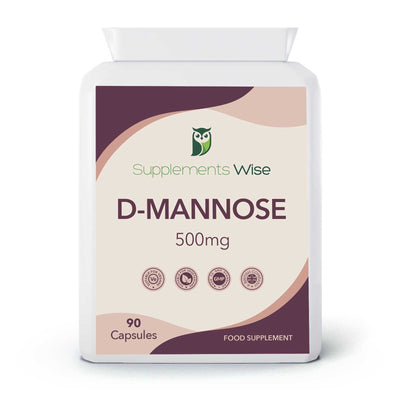
Made in the UK · GMP certified
90 vegan capsules · 500mg per capsule
- Four capsules deliver the 2g dose used in the trials
- Pure D-mannose, no fillers or proprietary blends
- Vegan HPMC capsule shell
Vegan · 30-day returns · Free UK shipping
In this article
- What is d-mannose and how does it work?
- What did the 2024 JAMA trial actually find?
- What is the standard d-mannose dose?
- Capsules or powder, does the form matter?
- Is it better to take d-mannose with cranberry?
- How long should you take d-mannose for?
- When is the best time of day to take d-mannose?
- Who should not take d-mannose?
- Frequently asked questions
What is d-mannose and how does it work?
D-mannose is a naturally occurring simple sugar found in small amounts in cranberries, apples and other fruits. Unlike glucose, it is largely unmetabolised and is excreted in the urine within a few hours of being swallowed.
The proposed mechanism is straightforward. D-mannose binds to the fimbriae, the finger-like projections on E. coli bacteria, and prevents them from sticking to the bladder wall. The bacteria are then meant to be flushed out during urination.
That mechanism is biologically plausible and shown in laboratory work, which is why D-mannose became a popular over-the-counter option for women with recurrent UTIs. The question is whether the lab effect translates into a meaningful clinical benefit in real patients, and that is where the recent evidence has shifted.
What did the 2024 JAMA trial actually find?
The MERIT trial, published in JAMA Internal Medicine in 2024, is the largest and most rigorous study of D-mannose for UTI prevention to date. It ran across 99 UK general practices, included 598 women with recurrent UTIs, and used a placebo-controlled, double-blind design.
Participants took 2g of D-mannose powder or a matched placebo once daily for six months. The headline result: 51.0% of the D-mannose group had a subsequent UTI compared with 55.7% on placebo, a difference that was not statistically significant.
What the Research Says
Hayward et al., 2024, JAMA Internal Medicine (DOI: 10.1001/jamainternmed.2024.0801): the MERIT placebo-controlled trial in 598 UK women found no significant benefit of 2g daily D-mannose over placebo for preventing recurrent UTI. Kranjcec et al., 2014, World Journal of Urology (DOI: 10.1007/s00345-013-1091-6): an earlier open-label trial of 308 women reported fewer recurrences on 2g daily D-mannose compared with no treatment, but lacked blinding.
The honest reading is that the strongest evidence does not support D-mannose as a reliable preventer of recurrent UTIs at the 2g dose. Some women still report subjective benefit, and it remains low-risk, but the prevention-only claim should be retired. For an active infection or any blood in urine, the NHS UTI guidance is the first stop.
What is the standard d-mannose dose?
The dose used in both the 2014 and 2024 trials is 2g (2,000mg) of D-mannose, once daily, dissolved in 200ml of water. With 500mg capsules that translates to four capsules per day, taken together or split into two morning and two evening.
Smaller studies have explored 1g three times daily (3g total) for prevention and short courses of 1.5g to 2g twice daily around an acute episode. Higher doses are not clearly more effective and are more likely to cause mild bloating or loose stools.
The table below shows the doses studied for the situations people most commonly ask about. Always check with your GP or pharmacist before starting, especially if you take other medication.
| Situation | Studied Dose | Typical Duration |
|---|---|---|
| Daily prevention attempt | 2g once daily (4 x 500mg) | Up to 6 months, review with GP |
| Around antibiotic course | 2g once daily alongside treatment | During and 1 to 2 weeks after |
| Acute symptom support | 1.5g to 2g twice daily, short course | 3 to 5 days, see GP if no improvement |
| Maximum studied daily intake | 3g (1g three times daily) | Short-term, higher side effect risk |
D-mannose is not a substitute for antibiotics in a diagnosed UTI. Symptoms that last more than 48 hours, blood in urine, fever or back pain need a GP appointment, not a supplement.
Where to buy D-Mannose
In the UK: Shop our D-Mannose 500mg capsules - UK-made and dispatched the same working day. Prefer the 180 value pack?
Outside the UK: we don’t ship internationally yet, but D-Mannose is widely available worldwide - find D-Mannose on iHerb.
Capsules or powder, does the form matter?
Most of the clinical trials used D-mannose powder stirred into about 200ml of water. Powder is absorbed quickly and gives complete dose flexibility, which is why researchers preferred it for the structured 2g protocol.
Capsules are more convenient for daily use and there is no published evidence that capsule D-mannose is less effective than powder at the same total dose. A 500mg capsule format simply asks you to take four to match the studied 2g, which most people prefer to weighing powder each morning.
Whichever form you choose, drink a full glass of water with the dose. Hydration is the part of the protocol with the strongest independent evidence for UTI prevention, regardless of what else you take.
Is it better to take d-mannose with cranberry?
Cranberry and D-mannose work on a similar mechanism, blocking E. coli adhesion to the bladder wall, but through different molecules. A 2023 Cochrane review concluded that standardised cranberry products with documented PAC content can reduce UTI recurrence in some women, and the 2025 AUA guideline update strengthened that position.
There is no head-to-head trial of D-mannose plus cranberry against either one alone, so we cannot say the combination is proven better. The mechanistic case for using both is reasonable, the risk is low, and a clean cranberry extract is an evidence-backed addition.
For a head-to-head walk-through of the two options, see our cranberry vs D-mannose UK guide and the broader natural bladder support guide.
How long should you take d-mannose for?
The trial protocols ran for three to six months of daily 2g dosing. There is no defined maximum duration in healthy adults, and side effects in studies were comparable to placebo over six months.
A sensible self-trial is to commit to three months of consistent daily use, ideally alongside cranberry and good hydration, then take stock with your GP. If you have not seen a clear reduction in UTI frequency, the realistic conclusion is that D-mannose is not doing much for you and a different prevention plan is worth exploring.
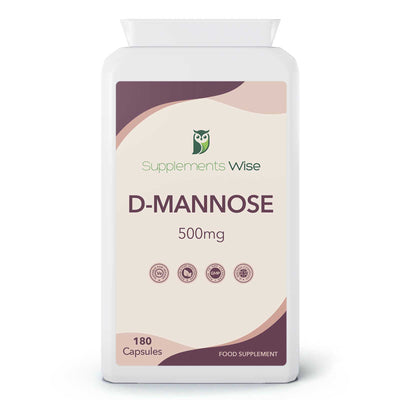
Best valueMade in the UK · GMP certified
D-Mannose 500mg Capsules, 180 Value Pack
180 vegan capsules · 45-day course at the 2g dose
- Four capsules a day gives the 2g trial dose for 45 days
- Better value per capsule than the 90 pack
- Pure D-mannose, no fillers, vegan HPMC shell
Vegan · 30-day returns · Free UK shipping
For short courses around antibiotics or a known trigger such as new sexual activity or travel, two to four weeks of daily use is more typical. Long-term continuous use is reasonable if you genuinely feel benefit, but it should not delay seeking proper medical assessment for recurrent infections.
When is the best time of day to take d-mannose?
D-mannose can be taken at any time of day, with or without food. Many people prefer evening dosing because urine concentration rises overnight, in theory giving the D-mannose more contact time with the bladder lining.
If you split the 2g dose into two halves, morning and evening works well for most routines. Drink a full glass of water with each dose to support the flushing mechanism the supplement is designed to assist.
If you are taking an antibiotic, separate the two by a couple of hours. There is no proven interaction, but it removes one variable from a confusing situation.
Who should not take d-mannose?
If you are wondering how much D-mannose to take daily for active UTI symptoms, speak to your GP first, as an active infection usually needs proper assessment and possibly antibiotics rather than self-treatment.
If you do choose to try D mannose for UTI prevention, stick to the 2g daily dose, drink plenty of water, and speak to your GP if symptoms persist.
D-mannose has a strong safety profile in healthy adults, with side effects in trials limited to mild bloating, loose stools or nausea at higher doses. A few groups should still be cautious or avoid it altogether.
Worth Knowing
Speak to your GP before taking D-mannose if you have diabetes (it is still a sugar and long-term effects on glycaemic control are not well studied), are pregnant or breastfeeding (insufficient safety data), take anticoagulants or diabetes medication (theoretical interactions), or are giving it to a child. The NHS UTI page is a sensible first stop for symptom advice and when to seek antibiotics.
Anyone with diagnosed kidney disease should also discuss D-mannose with their clinician before use, since it is cleared through the kidneys. For everyone else, the realistic framing is a low-risk, modest-benefit adjunct, not a replacement for medical advice or antibiotic treatment.
Key Takeaway
Stick to the 2g daily dose used in the trials, give it three months, and pair it with hydration and a standardised cranberry. Treat the 2024 JAMA result honestly: D-mannose is not a proven preventer of recurrent UTIs, but it is low-risk and may still help some women as part of a broader plan. Always involve your GP for active symptoms or recurrent infections.
Frequently asked questions
How much D-mannose should I take per day?
The dose used in clinical trials is 2g (2,000mg) once daily, equivalent to four 500mg capsules. Take it with a full glass of water. Higher doses up to 3g have been studied but do not appear more effective and may cause mild digestive side effects.
How much D-mannose should I take daily to prevent a UTI?
The studied prevention dose is 2g per day for up to six months. Be aware that the 2024 MERIT trial in 598 UK women did not find a significant benefit over placebo, so this should sit alongside hydration, cranberry and lifestyle measures rather than as a standalone fix.
How quickly does D-mannose work?
D-mannose appears in urine within a few hours of swallowing it, but it is not an acute treatment for an established UTI. Trials tested it as a daily preventive over three to six months, not as a quick remedy. See your GP for active symptoms rather than relying on a supplement.
Should I take D-mannose with food or on an empty stomach?
Either is fine and there is no clinical evidence that timing with food affects how well D-mannose works. Some people prefer between meals with a large glass of water, which is sensible for hydration regardless. Consistency matters more than the exact moment of dosing.
Can I take D-mannose with cranberry?
Yes, the two are commonly combined and have complementary anti-adhesion mechanisms. There is no head-to-head trial showing the combination is superior, but the risk profile is low and a standardised cranberry extract has its own evidence base in recent guidelines.
Is long-term D-mannose safe?
In trials lasting up to six months D-mannose was well tolerated with side effects similar to placebo. Long-term safety beyond six months has not been formally studied, although no significant concerns have emerged. People with diabetes should speak to their GP since D-mannose is a sugar.
Is D-mannose better as a powder or capsules?
The trials used powder, but there is no published evidence that capsules are less effective at the same 2g dose. Capsules are more convenient and easier to dose accurately. Four 500mg capsules match the studied protocol if you prefer that format.
D-mannose remains one of the most popular over-the-counter options for women with recurrent UTIs, and the 2g dose used in the clinical trials is the right number to work with if you choose to try it. Take it daily with plenty of water, give it three months, and treat it as a low-risk adjunct alongside hydration and cranberry rather than a standalone fix.
Try the 2g Daily D-Mannose Protocol
Four 500mg capsules a day, matching the dose used in the published trials. Pure D-mannose, vegan HPMC, UK GMP made, no proprietary blends.
Shop D-Mannose 500mgUK GMP-certified · Vegan · 30-day returns · Free UK shipping
This article is for information only and is not medical advice. Food supplements should not replace a varied diet or a healthy lifestyle. Speak to your GP or pharmacist before starting any new supplement, especially if you are pregnant, breastfeeding, taking medication or managing a health condition.