Supplements for Brittle Nails: A UK Evidence Review

The supplements with the best UK evidence for brittle nails are biotin (2,500 to 10,000mcg daily for 12 to 24 weeks), specific bioactive collagen peptides (2.5g daily for 24 weeks), and choline-stabilised orthosilicic acid as a second-line option. Iron only matters if a blood test confirms low ferritin, and zinc only matters if dietary intake is genuinely low. Omega-3 fish oil is better for cuticle hydration than for the nail plate itself, and generic multivitamins do very little as a primary fix.
The honest 2026 reading from UK and international dermatology literature is that supplements help when they are matched to a specific cause and given a full three to six months, and waste money when they are layered five at a time as a beauty hack. The fastest gains usually come from cutting acetone polish remover, pausing gel manicures and wearing gloves for wet work, then layering one supplement on top.
This UK guide is written for adults whose nails peel in thin layers, snap before they have time to grow, or develop fine vertical ridges. It covers what each supplement actually does, the dose with trial backing, how long to give it, the red flags that mean GP-first not capsule-first, and the routine to follow over 12 to 24 weeks.
Key Takeaway
Match one supplement to your loudest nail symptom, run it for at least 12 weeks, and fix the external damage at the same time. Biotin for peeling and softness. Collagen peptides for slow growth. Iron only if a GP confirms deficiency. Cutting acetone remover, gels and dish water often does more in two months than any supplement does in six.
In this article
- Do supplements actually help brittle nails?
- What causes brittle nails, and why does the cause matter?
- How do you tell peeling from ridging, and what does each mean?
- Which lifestyle changes beat any supplement?
- Does biotin really work for brittle nails?
- Do collagen peptides do anything for nails?
- Is silicon (orthosilicic acid) worth trying after biotin?
- When should iron be on the list, and why do spoon nails need a GP?
- Do zinc and vitamin C add anything useful?
- Are omega-3 fats worth taking for nails?
- What does a sensible 12 to 24 week routine look like?
- When should you skip supplements and see a GP?
- Frequently asked questions
Do supplements actually help brittle nails?
Yes, but only for the right cause and only at the right dose. Biotin and specific bioactive collagen peptides have the most consistent trial data behind them, with modest but real improvements in nail firmness, growth rate and break frequency over three to six months. Choline-stabilised orthosilicic acid has one solid 20-week trial, and iron and zinc only earn their place when a deficiency is confirmed.
Roughly one in five UK adults reports brittle nails at some point, with rates higher in women, in adults over 50, and in occupations involving frequent wet work (hairdressers, nurses, chefs, dentists, cleaners). British Association of Dermatologists guidance on brittle nails still puts external protection and hand-care basics ahead of any oral supplement.
Treat the rest of this guide as a map: which supplement matches which symptom, what dose has trial evidence behind it, and how long to wait before judging it.
What causes brittle nails, and why does the cause matter?
Brittle nails are a symptom, not a disease, so the cause matters more than the supplement choice. The two broad buckets are external damage (water, soap, acetone polish remover, gel and shellac manicure cycles, gardening, hot washing up) and internal factors (low ferritin, low protein intake, thyroid disorders, certain medications, the natural thinning that comes with age).
A smaller share of cases links to dermatology conditions like psoriasis, lichen planus or fungal infection, and a tiny number point to serious systemic disease. Knowing which bucket you are in is what tells you whether biotin is the right answer or a blood test is.
If your nails sit in hot soapy water for an hour a day, no biotin tablet can outrun that. Equally, if your ferritin is genuinely low, three months of collagen will do less for your nails than a confirmed iron course.
How do you tell peeling from ridging, and what does each mean?
Dermatologists split brittle nails into two main patterns, and the pattern often points to the cause. Onychoschizia is horizontal splitting at the free edge, where the nail flakes off in thin sheets. It is the classic external-damage pattern (water, polish remover, gels, household chemicals), and biotin plus barrier protection is the first-line answer.
Onychorrhexis is vertical ridging or longitudinal splits running from the cuticle to the tip. This is more often linked to internal causes: low iron, ageing, thyroid disorder, or skin conditions like psoriasis. Onychorrhexis is the pattern that should make you think about a blood test before a beauty supplement.
If you have both, treat the loudest feature first and run a single supplement for 12 to 24 weeks before stacking a second.
Which lifestyle changes beat any supplement?
Four free changes outperform most capsules in the first two months. Cut back on acetone-based polish remover, give your nails a four-week break between gel or shellac manicures, wear cotton-lined rubber gloves for washing up and gardening, and apply a plain hand cream containing urea or lactic acid after every hand wash.
One small habit shift makes more difference than people expect: keep a tube of hand cream beside every sink in the house. The nail plate is mostly keratin, and it absorbs and loses water faster than the rest of the skin. That is why hairdressers, nurses, chefs and dentists are over-represented in brittle-nail clinics.
Filing matters too. File in one direction with a fine-grit emery board, never with a metal file or a sawing motion. Sawing back and forth heats the nail plate and prises the keratin layers apart.
Does biotin really work for brittle nails?
Biotin (vitamin B7) is the most-searched UK nail supplement and the one with the longest evidence trail. It sits in the keratin synthesis pathway, the same pathway responsible for the protein your nails are built from.
The pivotal trial is Hochman, Scher and Meyerson 1993: 35 adults with brittle nails took 2,500 micrograms of biotin daily for 6 to 9 months. 63 per cent showed clear clinical improvement in firmness, hardness and resistance to splitting (Hochman et al., 1993, Cutis, PMID: 8477615). A separate scanning electron microscopy study by Colombo and colleagues reported a 25 per cent increase in nail plate thickness in women taking the same dose for at least six months (Colombo et al., 1990, J Am Acad Dermatol, DOI: 10.1016/0190-9622(90)70345-i).
The honest 2018 reading from Lipner and Scher in the Journal of the American Academy of Dermatology is that biotin helps when there is genuine brittleness or deficiency, and adds little for people with healthy nails already (Lipner and Scher, 2018, DOI: 10.1016/j.jaad.2018.02.018). Biotin is a fair pick if your nails are visibly brittle. It is not a daily insurance policy if they are not.
What the Research Says
Hochman et al., 1993 (Cutis). 35 adults with brittle nails, 2,500mcg biotin daily for 6 to 9 months. 63 per cent showed clinical improvement in firmness and resistance to splitting (PMID: 8477615). Colombo et al., 1990 (J Am Acad Dermatol) reported a 25 per cent increase in nail plate thickness on the same dose over 6 months (DOI: 10.1016/0190-9622(90)70345-i).
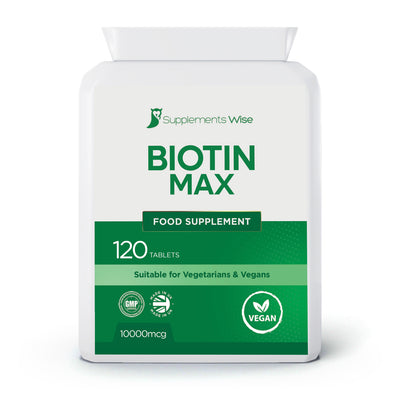
Biotin 10,000mcg Tablets, 120 Vegan Tablets
High-strength biotin in a once-a-day tablet. A clean four-month supply for an honest 12 to 24 week brittle-nail trial. UK GMP made.
UK GMP-certified · Vegan · 30-day returns · Free UK shipping
The 10,000 microgram daily dose used in most modern UK products is well above the older trial dose of 2,500 micrograms. There is no upper limit set by EFSA and excess biotin is excreted in urine, but the higher dose can interfere with some blood tests, so flag it with your GP before any thyroid or troponin panel.
Do collagen peptides do anything for nails?
Collagen is the second most-evidenced supplement for brittle nails and the one that finally moved out of speculation in 2017. Hydrolysed collagen peptides are short protein fragments your gut can absorb, and a small fraction appear to act as signalling molecules at the cells that build keratin and connective tissue.
Hexsel and colleagues followed 25 women taking 2.5g of specific bioactive collagen peptides (VERISOL) daily for 24 weeks. Nail growth rate rose 12 per cent, broken-nail frequency fell 42 per cent, and 64 per cent reported global clinical improvement (Hexsel et al., 2017, J Cosmet Dermatol, DOI: 10.1111/jocd.12393). The effect kept improving for four weeks after participants stopped, which fits the slow nail replacement timeline.
Collagen is not magic and is not interchangeable with eating more chicken. The trial used a specific hydrolysed peptide blend at a specific dose, which is why generic protein powders and low-dose multi-ingredient pills do not produce the same results.
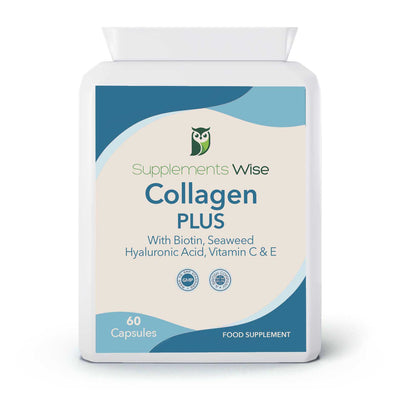
Collagen Complex Capsules with Hyaluronic Acid, 60 Capsules
500mg marine collagen with hyaluronic acid, biotin, vitamins C and E in one daily capsule, formulated for skin, hair and nails together. 2-month supply.
UK GMP-certified · Marine sourced · 30-day returns · Free UK shipping
Is silicon (orthosilicic acid) worth trying after biotin?
Silicon is involved in the cross-linking of collagen and keratin, both of which sit underneath nail strength. Most UK adults get small amounts from leafy greens, bananas, whole grains and beer, but absorption is poor unless silicon comes in a soluble form.
The strongest trial used choline-stabilised orthosilicic acid at 10mg silicon per day in women with photo-damaged skin and reported significant reductions in nail brittleness on a visual analogue scale after 20 weeks (Barel et al., 2005, Arch Dermatol Res, DOI: 10.1007/s00403-005-0584-6). The effect was modest, the population was small, but the safety profile is good.
Supplements Wise does not currently sell a standalone orthosilicic acid product, and generic silica or horsetail capsules do not deliver the same form used in the trial. If you have already given biotin and collagen a fair run, a UK pharmacy-stocked choline-stabilised silicon product is a reasonable third experiment.
When should iron be on the list, and why do spoon nails need a GP?
Iron is the supplement most often missed by people scrolling beauty aisles, and the one most worth taking seriously. Low iron stores are linked to koilonychia (spoon-shaped nails that curve up at the edges) and to longitudinal ridging in milder cases.
If your nails look flat or scooped and you also have any combination of unusual fatigue, pale skin, breathlessness, heavy periods or restless legs, this is a GP conversation rather than a supplement choice. NHS guidance on iron-deficiency anaemia covers the symptom checklist and what to expect from a GP visit.
Ferritin and a full blood count are cheap NHS tests, and iron supplementation without testing is a poor idea because excess iron has its own risks. UK women under 50, vegetarians, vegans, frequent blood donors and anyone with heavy menstrual bleeding sit in the higher-risk groups. Iron-rich foods paired with vitamin C are the right first move, and a tested deficiency is what should drive any supplement decision.
Do zinc and vitamin C add anything useful?
Zinc supports keratin synthesis and is concentrated in the rapidly dividing cells at the nail matrix. Low zinc has been linked to Beau lines (transverse depressions across the nail) and to slowed nail growth in deficiency states. Most UK adults eating a varied diet are not zinc deficient, but vegetarians, older adults and people with malabsorption conditions are more often at the lower end.
Vitamin C is less about the nail itself and more about iron absorption and collagen synthesis. The amount from one 80ml glass of orange juice or a small portion of strawberries is enough to meaningfully boost non-haem iron absorption at the same meal, which is the practical move worth remembering.
Supplements Wise does not currently stock standalone zinc citrate or vitamin C as single ingredients, although both appear as supporting actives in the Collagen Complex with Hyaluronic Acid range and the Collagen Type 1 with Vitamin C range.
Are omega-3 fats worth taking for nails?
Omega-3 fatty acids show up in most nail supplement listicles, but the evidence is thinner than people think. There is no convincing trial that fish oil at standard doses meaningfully changes nail brittleness scores in healthy adults.
The case for omega-3 is more about nail-bed hydration than nail-plate strength. EPA and DHA help maintain healthy lipid layers in skin including the cuticle and the nail fold, which can reduce hangnails and dryness around the edges, even if the nail plate itself does not change.
If you already take omega-3 for heart, brain or joint reasons, classing nail benefits as a small bonus is fair. Starting an omega-3 product purely for brittle nails is not the right priority when biotin or collagen is available at the same price.
| Supplement | Evidence grade | Typical daily dose | Best candidate |
|---|---|---|---|
| Biotin (vitamin B7) | Moderate | 2,500 to 10,000mcg, 12 to 24 weeks | Peeling, splitting, soft nails |
| Hydrolysed collagen peptides | Moderate (single solid trial) | 2.5g bioactive peptides, 24 weeks | Slow growth, frequent breaks |
| Choline-stabilised orthosilicic acid | Modest, one small trial | 10mg silicon, 20 weeks | Tried biotin, want a step up |
| Iron (only if deficient) | Strong when ferritin is low | 14 to 65mg elemental, GP-guided | Spoon or longitudinally ridged nails |
| Zinc (only if deficient) | Weak unless intake is low | 10 to 25mg, 8 to 12 weeks | Vegetarians, older adults |
| Omega-3 fish oil | Weak for the nail plate | 1,000mg EPA plus DHA, ongoing | Dry cuticles and hangnails |
| Generic multivitamin | Very weak as a primary fix | Once daily | Patchy diet, broad nutrient gap |
What does a sensible 12 to 24 week routine look like?
The mistake most people make is taking five things at once. A cleaner approach is to match the most obvious feature of your nails to the supplement with the best evidence for that pattern, run it for at least 12 weeks, then stack a second product only if the first has not delivered.
| Loudest nail symptom | First step | Supplement worth considering |
|---|---|---|
| Peeling in thin horizontal layers | Cut polish remover, gloves for wet work | Biotin 10,000mcg daily, 16 weeks |
| Slow growth and frequent breaks | File one direction only, urea hand cream | Hydrolysed collagen peptides 2.5g, 24 weeks |
| Vertical ridging, spoon shape, fatigue | GP ferritin + full blood count test | Iron, only if deficiency confirmed |
| Cuticles always dry, hangnails | Cuticle oil twice daily | Omega-3 or collagen complex |
| Already tried biotin, no change | Recheck habits, gels and diet | Add collagen peptides or orthosilicic acid |
Take a clear, dated photo of your hands at week zero and week 12, in the same light and from the same angle. Nail change is slow enough that memory plays tricks, and a side-by-side photo is the only honest at-home assessment most people can make. If a supplement has not produced a visible difference at 12 to 16 weeks, stop it, and either move to a second product or accept that the lifestyle work is doing the heavy lifting.
When should you skip supplements and see a GP?
Some nail changes need a GP appointment rather than a beauty supplement. Book a routine appointment if you have any of the following.
- Spoon-shaped nails (koilonychia) or clubbed nails rounded and bulging at the fingertips.
- New dark vertical lines through the nail plate, especially a single line.
- Entire nail splitting away from the bed (onycholysis) without obvious injury.
- Nail changes alongside unusual fatigue, breathlessness or hair loss: thyroid and iron-status screen needed.
- Yellow, thickened, crumbling nails: possible fungal infection requiring topical or oral antifungal.
- Pitting, ridging plus a skin rash: possible psoriasis or lichen planus.
Your GP can order the simple bloods (full blood count, ferritin, B12, vitamin D, thyroid function, U+Es, LFTs) that turn guessing into a real baseline. The British Skin Foundation also lists UK dermatology services for cases that need specialist follow-up.
Worth Knowing
High-dose biotin (5,000mcg or more daily) can interfere with immunoassays used for thyroid, troponin (a heart-attack marker) and several hormone tests, producing falsely high or low results. UK pathology labs are aware of this and most ask you to stop biotin for 48 hours before a blood test. Tell your GP and the phlebotomist if you are taking 5,000mcg or more daily.
Key Takeaway
Pick one supplement matched to your loudest nail symptom, fix the external damage at the same time, and judge it at 12 to 24 weeks with a dated before-and-after photo. Stacking three products from day one means you will never know which one helped.
Frequently asked questions
How long until I see results from supplements for brittle nails?
Plan for 12 to 24 weeks before judging anything. Fingernails grow roughly 3mm per month, so new growth needs three to six months to reach the free edge where you can see it. The Hexsel 2017 collagen trial only peaked 4 weeks after participants stopped, which is a realistic timeline to use.
Is 10,000mcg of biotin daily too much?
10,000mcg is well within the dose range used in modern UK products, and there is no upper limit set by the European Food Safety Authority because excess biotin is water soluble and excreted in urine. The catch is that high-dose biotin can interfere with thyroid and heart blood tests, so tell your GP and nurse before any blood draw. Most people with brittle nails do well at 2,500 to 10,000mcg.
Does collagen actually help nails or is it just marketing?
The Hexsel 2017 trial showed a 12 per cent increase in nail growth rate and 42 per cent fewer broken nails in 25 women taking 2.5g of specific bioactive collagen peptides for 24 weeks. The evidence is real but narrow, and a generic protein powder is not the same product. If you try it, pick a hydrolysed collagen at the studied dose and commit to a full 24 weeks.
Should I take iron for brittle nails?
Only after a GP ferritin and full blood count test confirms low iron stores. Iron is the most useful supplement when ferritin is low, particularly with spoon-shaped nails or vertical ridging, but supplementing without testing carries real risks. Women under 50, vegetarians, vegans and anyone with heavy periods are the groups most worth testing.
Can biotin mess up my blood tests?
Yes, high-dose biotin can interfere with immunoassays used for thyroid function, troponin (a heart attack marker) and several hormone tests, producing falsely high or low results. UK pathology labs are aware of this and most ask you to stop biotin for 48 hours before a blood test. Tell your GP if you are taking 5,000mcg or more daily.
Is silica or silicon better than biotin for nails?
Biotin has a longer and larger evidence base and is the sensible starting pick. Choline-stabilised orthosilicic acid at 10mg per day has one solid 20-week trial (Barel 2005) and is a fair second experiment if biotin has not helped at 16 weeks. Generic silica or horsetail capsules deliver poorly absorbed silicon and do not match the trial product.
What stops me getting any benefit from a nail supplement?
The biggest culprit is ongoing external damage from acetone polish remover, frequent gel manicures or unprotected wet work, which biotin cannot outrun. The second is judging the supplement at 4 weeks instead of 12 to 24, before any new nail has even grown out. The third is an undiagnosed cause such as iron deficiency, thyroid disorder or psoriasis, which a beauty supplement was never going to fix.
The honest bottom line on supplements for brittle nails in 2026 is small, real, and slow. Biotin and specific bioactive collagen peptides are the two clearest picks, with iron earning a place only after a confirmed deficiency. Fix the external damage first, run one supplement for a full 12 to 24 weeks, and use a dated before-and-after photo as your judge.
Start a 16-week biotin trial
One 10,000mcg tablet a day, cotton-lined gloves for wet work, a dated before-and-after photo at week zero and week 16. Stop and see your GP if your nails are spoon-shaped or any red flag in this guide appears.
Start the 16-Week TrialUK GMP-certified · Vegan · 30-day returns · Free UK shipping
This article is for information only and is not medical advice. Food supplements should not replace a varied diet or a healthy lifestyle. Speak to your GP or pharmacist before starting any new supplement, especially if you are pregnant, breastfeeding, taking medication or managing a health condition.