Candida Symptoms: How to Spot Candida Overgrowth and What Actually Helps

Persistent bloating, brain fog, sugar cravings and recurring thrush are symptoms UK adults often live with for months before joining the dots. When several of them show up together, candida overgrowth is one of the most commonly overlooked causes in general practice, because it does not show up on a standard blood test and the symptoms overlap with IBS, perimenopause, thyroid issues and low iron.
Candida is a yeast that lives naturally in the gut, mouth, skin and vagina. In small amounts it is harmless and does its job as a commensal. Problems start when the balance tips and candida multiplies beyond what the gut flora, stomach acid and immune system can keep in check.
This UK evidence guide walks through what the seven most common overgrowth symptoms actually feel like, the causes worth tackling first, which supplements have real trial data behind them, what the honest UK candida protocol looks like across an 8 to 12 week window, and the red flags that should send you to your GP before you start buying capsules.
Key Takeaway
Candida overgrowth produces symptoms across several body systems, not just digestive ones. Bloating, brain fog, fatigue, sugar cravings, skin issues and recurring thrush are the most common signs. A multi-ingredient approach that combines antifungal compounds (caprylic acid, oregano, garlic), beneficial bacteria, and immune-supporting nutrients performs more reliably than a single-agent product, and works best alongside a lower-sugar diet for at least eight weeks.
In this article
- What is candida overgrowth and why does it matter?
- What are the most common candida overgrowth symptoms?
- How does candida cause bloating and digestive issues?
- Can candida really cause brain fog and fatigue?
- What actually causes candida to overgrow in the UK?
- Which supplements have real evidence against candida?
- Why does a multi-ingredient formula usually beat a single antifungal?
- What diet and lifestyle changes matter most?
- What is the Herxheimer reaction and should you worry about it?
- How long does a candida protocol take to work?
- When should you see your GP about candida symptoms?
- Frequently asked questions
What is candida overgrowth and why does it matter?
Candida albicans is the most common candida species in the human body. It normally lives quietly in the gut, mouth, skin and vagina, kept in balance by beneficial bacteria, stomach acid, bile flow and a functioning immune system. In that balanced state it is a commensal, not a disease.
Overgrowth happens when the balance tips. A course of broad-spectrum antibiotics, a high-sugar diet, long-running stress, oestrogen fluctuations, or a period of immune suppression can each shift the environment in candida's favour. Once its numbers rise past a threshold, candida can switch from its rounded yeast form into a filamentous, more invasive hyphal form and start producing byproducts that reach beyond the gut.
The 2020 Current Opinion in Microbiology review from Kumamoto and colleagues walks through this "good commensal, bad opportunist" transition in detail and links intestinal candida overgrowth to systemic inflammatory signalling and immune dysregulation (Kumamoto et al., 2020, DOI: 10.1016/j.mib.2020.05.006). The clinical message is that gut candida is not just a local nuisance. When it is overgrown, its effects show up across several body systems at once.
What are the most common candida overgrowth symptoms?
Candida rarely produces one clean symptom. Most people experience a cluster across two or three body systems, which is exactly why it is missed by symptom-based triage and dismissed as "just IBS" or "just tiredness".

| Body system | Common symptoms | Why it happens |
|---|---|---|
| Digestive | Bloating, gas, constipation, diarrhoea, nausea | Candida ferments sugars into gas and disrupts flora balance |
| Neurological | Brain fog, poor concentration, memory blips | Acetaldehyde and other metabolites cross the blood-brain barrier |
| Energy | Chronic fatigue, afternoon energy crashes | Immune load plus nutrient malabsorption drains reserves |
| Skin and nails | Fungal nail infections, athlete's foot, eczema flares, rashes | Systemic yeast imbalance surfaces on skin and nail beds |
| Urogenital | Recurring thrush, some UTIs, vaginal itching | Candida colonises mucous membranes and outcompetes lactobacilli |
| Cravings | Intense sugar and refined carbohydrate cravings | Candida feeds on sugar and hijacks reward signalling |
| Immune | Frequent colds, slow recovery, chronic sinus issues | Overgrowth ties up immune resources and shifts cytokine balance |
How does candida cause bloating and digestive issues?
Bloating is the symptom most tightly associated with candida overgrowth, and there is a straightforward mechanism behind it. Candida ferments dietary sugars and refined carbohydrates in the small intestine, producing carbon dioxide and other gases that stretch the gut wall and produce that recognisable "pregnant after lunch" look and heaviness.
Alternating constipation and diarrhoea is the other hallmark. As candida crowds out the beneficial bacteria that regulate transit time, motility becomes unpredictable. Many UK patients describe good days and bad days on the same diet, which is a strong tell that the underlying flora is unstable rather than a specific food being the culprit.
Nausea and heaviness after meals, particularly meals higher in sugar or alcohol, complete the digestive picture. If digestive symptoms have persisted for weeks despite normal fibre, water and sleep, and a GP has ruled out coeliac disease, inflammatory bowel disease and thyroid issues, candida overgrowth is a reasonable next hypothesis to test.
Can candida really cause brain fog and fatigue?
Yes, and this is the symptom cluster people find hardest to explain to family or a busy GP. The mechanism is candida's own metabolism. When candida ferments sugars it produces acetaldehyde, the same aldehyde your liver processes after a glass of wine. Chronic low-level acetaldehyde load can cross the blood-brain barrier and interfere with neurotransmitter function, and that shows up as persistent mental cloudiness, word-finding trouble and short-term memory blips.
The fatigue is not the tired-after-a-late-night type. It is a deep, immune-load fatigue that gets worse through the afternoon and does not clear with a good night's sleep. That is because the immune system is running an extra background workload against the overgrowth, and cortisol, energy metabolism and micronutrient status are all being nudged in an unhelpful direction at once. See our brain fog supplements UK guide for the wider brain fog differential, including B12, iron and perimenopause.
What actually causes candida to overgrow in the UK?
Most UK cases of candida overgrowth are triggered by one or more of five identifiable factors. Addressing them is more important than any capsule.
Antibiotics are the classic trigger. A single broad-spectrum course kills the good bacteria alongside the bad, and the gap in gut flora is exactly the space candida is waiting to fill. Symptoms often appear four to eight weeks after a course finishes, which is late enough that the connection gets missed.
A high-sugar UK diet keeps candida fed. Sweetened coffees, ultra-processed snacks, alcohol and dried fruit provide the fermentable substrate that overgrowth needs to sustain itself. Reducing sugar is the single biggest lever most people can pull.
Chronic stress raises cortisol, which suppresses immune function and pushes blood sugar upward. Both changes tilt the gut environment toward candida. This is why overgrowth often appears in the six months after a major life event.
Oestrogen fluctuations, particularly during pregnancy, the perimenopause transition or oral-contraceptive use, promote candida growth on mucous membranes. This is part of why recurrent thrush is disproportionately a female health issue in the UK.
Immune suppression from steroid use, an unmanaged autoimmune condition, or an untreated diabetes diagnosis all remove one of the checks that keeps candida contained. If you fit any of these categories, a GP conversation should come before a supplement plan.
Which supplements have real evidence against candida?
A short list of ingredients has meaningful in vitro and clinical evidence against candida. Every product on the UK market that claims to work is a variation on this same short list, and the most useful formulas combine antifungal compounds, beneficial bacteria and immune-supporting nutrients in one capsule rather than asking you to buy five separate bottles.
| Ingredient | How it helps | Evidence grade |
|---|---|---|
| Caprylic acid (medium-chain fatty acid) | Disrupts candida cell membranes and slows hyphal switching | Strong (in vitro, foundational trial data) |
| Oregano and its carvacrol / thymol content | Inhibits candida biofilm formation and induces membrane stress | Strong (multiple peer-reviewed studies) |
| Garlic (allicin) | Broad antifungal activity, complements caprylic acid | Moderate to strong (in vitro and small human) |
| Lactobacillus acidophilus + Bifidobacterium blends | Compete with candida for adhesion sites, produce lactic acid | Strong (clinical trials in recurrent thrush) |
| Grapefruit seed extract | Broad-spectrum antimicrobial, traditional in candida protocols | Moderate (mostly in vitro) |
| Zinc | Supports the immune arm that keeps candida in check | Strong (established nutrient) |
| Biotin | May slow candida's shift from yeast form to invasive hyphal form | Moderate (emerging) |
The foundational human-relevant data on medium-chain fatty acids sits in Bergsson and colleagues' 2001 paper in Antimicrobial Agents and Chemotherapy. Working across three clinical strains of Candida albicans, they showed that caprylic acid (C8) and capric acid (C10) killed candida at low micromolar concentrations within minutes, and that the effect was mediated by direct membrane disruption rather than a slow metabolic hit (Bergsson et al., 2001, DOI: 10.1128/AAC.45.11.3209-3212.2001).
What the Research Says
Bergsson et al., 2001, Antimicrobial Agents and Chemotherapy. In vitro testing of caprylic (C8), capric (C10) and lauric (C12) fatty acids against three clinical strains of Candida albicans. Capric and caprylic acid produced fast, complete killing at low concentrations within 1 to 10 minutes via direct cell-membrane disruption. This paper is the reason caprylic acid remains the most-cited natural antifungal in modern candida formulas (DOI: 10.1128/AAC.45.11.3209-3212.2001).
On the oregano side, more recent work has focused on carvacrol, its main active phenol. A 2021 study in Biomedicine and Pharmacotherapy found that carvacrol significantly reduced both mature candida biofilm biomass and metabolic activity, which matters because biofilms are what make chronic overgrowths hard to shift with antifungals alone (Chami et al., 2021, DOI: 10.1016/j.biopha.2021.112218).
Why does a multi-ingredient formula usually beat a single antifungal?
Candida is stubborn for two reasons. It forms biofilms that shield individual yeast cells from any single agent, and it can develop resistance to a single antifungal over weeks. A formula that hits candida from three or four different angles at once (membrane disruption, biofilm inhibition, competitive exclusion by probiotics, and immune support) reduces the resistance window and reaches parts of the population that a single ingredient misses.
Our Candida Support Capsules combine fifteen ingredients into a single vegan capsule for exactly this reason. The core of the formula is calcium caprylate at 212.5mg per capsule, providing the trial-referenced caprylic acid dose. A botanical blend of garlic, oregano, thyme, cloves and cinnamon bark covers the biofilm and quorum-sensing angle. Lactobacillus acidophilus and a Bifidobacterium blend compete directly with candida for gut adhesion sites, and zinc, biotin, quercetin, grapefruit seed extract, aloe vera and rosemary leaf round out the immune, digestive-soothing and antioxidant support.
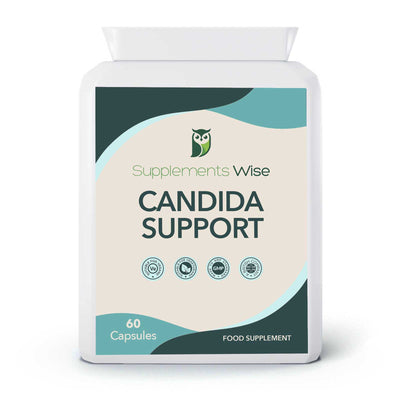
Candida Support, 60 Vegan Capsules
15-ingredient candida balance formula: 212.5mg caprylic acid (as calcium caprylate) plus garlic, oregano, thyme, cloves, cinnamon, Lactobacillus acidophilus, Bifidobacterium, zinc, biotin, quercetin, grapefruit seed extract, aloe vera and rosemary. One to three capsules daily with food, up to a 60-day protocol per bottle.
UK GMP-certified · Vegan · 30-day returns · Free UK shipping
If your overgrowth was triggered by a course of antibiotics or a long antifungal protocol, rebuilding the beneficial bacteria population directly is the second half of a sensible plan. A daily Probiotic Complex with 10 billion CFU across six strains pairs cleanly with the Candida Support Capsules and gives the friendly bacteria a fighting chance to recolonise.

Probiotic Complex, 10 Billion CFU, 6 Strains, 120 Vegan Capsules
10 billion CFU per capsule from Lactobacillus acidophilus, L. plantarum, L. paracasei, L. rhamnosus, Bifidobacterium bifidum and B. lactis, plus prebiotic FOS to feed the strains. Four-month supply at one capsule daily. Rebuilds gut flora after antibiotic-triggered candida.
UK GMP-certified · Vegan · 30-day returns · Free UK shipping
What diet and lifestyle changes matter most?
Supplements move the dial fastest when they sit on top of a low-sugar UK diet. Cutting refined sugar, alcohol, dried fruit, fruit juice, sweetened yoghurts and processed white carbs for the first four to six weeks removes candida's main fuel source and gives the antifungal side of your protocol clean air to work in.
Aim for a plate that is half non-starchy vegetables, a palm-sized portion of quality protein, one to two thumbs of healthy fat, and a fist of unrefined carbohydrate like oats, sweet potato or basmati rice. Fermented foods like sauerkraut, kefir, kimchi and live natural yoghurt introduce beneficial bacteria naturally. Two to three litres of water a day supports the mild detox load that comes with die-off.
An Apple Cider Vinegar capsule before larger meals is a low-risk addition that helps maintain the acidic stomach environment that keeps candida in check further down. Sleep, movement and stress management earn their place too. Poor sleep, a sedentary week and unresolved stress all push cortisol upward, which nudges gut conditions back toward candida.
What is the Herxheimer reaction and should you worry about it?
In the first one to two weeks of a proper antifungal protocol, some people feel worse before they feel better. Headaches, added fatigue, mild flu-like malaise, a bit more bloating and a general "off" feeling are all common. This is the Herxheimer reaction (often shortened to "Herx" or "die-off"), and it happens because the antifungals are killing candida faster than the body can clear its byproducts.
The pragmatic UK approach is not to panic. Reduce your capsule dose to one a day, drink an extra litre of water, add a fibre-rich vegetable to every meal to bind and eliminate byproducts, and give the reaction 3 to 5 days to settle. If symptoms are severe or persist beyond a week, stop the protocol and speak to your GP or a registered nutritional therapist.
Worth Knowing
Herxheimer symptoms are not proof the protocol is working, and their absence is not proof it is not. Some people feel no die-off at all and still get the same eight-week result. Track your original symptoms (bloating, brain fog, sugar cravings, thrush frequency) rather than chasing a die-off feeling as a marker of progress.
How long does a candida protocol take to work?
Give any candida plan at least eight weeks before you decide it is not working. The typical timeline for UK adults on a Candida Support Capsule plus lower-sugar-diet protocol looks roughly like this.
| Timeframe | What usually shifts | What to keep doing |
|---|---|---|
| Week 1 to 2 | Possible mild Herx symptoms, sugar cravings peak then fade | Hold the line on sugar, hydrate, sleep |
| Week 2 to 3 | Bloating and gas begin to reduce, digestion feels less unpredictable | Add a fermented food daily |
| Week 4 to 6 | Brain fog lifts, afternoon energy improves | Introduce a probiotic complex if not already using one |
| Week 6 to 8 | Thrush recurrence gap widens, skin and nail symptoms start to clear | Reintroduce whole-food carbs gradually |
| Week 8 to 12 | Symptoms stable at a much lower baseline, cravings back to normal | Step down to a maintenance dose, keep the probiotic running |
After a full 8 to 12 week run, most people drop the antifungal side to a maintenance dose (one capsule a day, or a few days a week) and keep the daily probiotic running for another three months to lock in the gut flora rebuild. If symptoms return within a few weeks of stopping, that usually points to an unresolved trigger (sugar drift, unmanaged stress, recurrent antibiotics) rather than the protocol having failed.
When should you see your GP about candida symptoms?
Candida is a diagnosis of exclusion in general practice, which means the important step is ruling out conditions that mimic it. Book a GP appointment before self-treating if any of the following applies.
- Unexplained weight loss, blood in your stool, or a change in bowel habit lasting more than six weeks
- Recurring thrush at more than four episodes per year (needs to rule out undiagnosed diabetes or immune deficiency)
- Persistent oral thrush in an adult who is not on inhaled steroids (can be an immune-status warning)
- New severe fatigue, especially with pallor, low mood, or heavy periods (iron and thyroid checks first)
- Any candida-like symptoms during pregnancy or breastfeeding
- Suspected candida on top of a diagnosed autoimmune condition or on immunosuppressant medication
- Symptoms of diabetes: increased thirst, needing to urinate more often, unexplained weight loss
Your GP can arrange blood tests (HbA1c for diabetes, thyroid function, full blood count, coeliac screen, ferritin) and refer to gastroenterology or gynaecology if needed. Useful UK references while you sort the picture are the NHS thrush information page and the NHS IBS information page, since IBS overlaps heavily with candida symptoms in general practice.
Key Takeaway
A sensible UK candida protocol is a Candida Support Capsule daily with meals, a daily probiotic complex to rebuild the gut flora, a lower-sugar diet with fermented foods, and eight to twelve weeks of patience. Book a GP appointment first if any of the red flags above apply, or if symptoms fail to improve after eight weeks of a fair trial.
Frequently asked questions
How do I know if I have candida overgrowth?
The strongest signal is a cluster of symptoms across multiple body systems: persistent bloating, brain fog, chronic fatigue, sugar cravings and recurring thrush or fungal skin infections together are more suggestive than any one on its own. If several of these have persisted for more than six weeks, it is worth ruling out diabetes, thyroid issues, iron deficiency and coeliac disease with your GP before starting a protocol.
How long does it take to get candida under control?
Most people notice digestive improvements within 2 to 3 weeks of a consistent protocol. Brain fog and fatigue usually improve at week 4 to 6. Skin and thrush symptoms often take 8 to 12 weeks. Give any candida plan at least 8 weeks before deciding it has not worked.
What foods should I avoid with candida overgrowth?
Reduce refined sugar, alcohol, dried fruit, fruit juice, sweetened yoghurts and processed white carbs for the first 4 to 6 weeks. Focus instead on non-starchy vegetables, quality protein, healthy fats and naturally fermented foods like sauerkraut, kefir and kimchi. Most people can reintroduce moderate amounts of whole-food carbs from week 6 onwards.
Can candida really cause brain fog?
Yes. Candida produces acetaldehyde and other metabolites that can cross the blood-brain barrier and interfere with neurotransmitter function. That mechanism drives the persistent mental cloudiness, poor concentration and short-term memory blips people with overgrowth typically report.
What is a Herxheimer reaction and how do I manage it?
It is a temporary worsening of symptoms in the first 1 to 2 weeks of a candida protocol, caused by die-off byproducts entering the bloodstream faster than the body can clear them. Reduce your dose to one capsule a day, drink an extra litre of water, add a fibre-rich vegetable at each meal, and give it 3 to 5 days to settle. If severe or persistent, stop and speak to your GP.
Is caprylic acid effective against candida?
Caprylic acid is the most-cited natural antifungal against Candida albicans. The foundational trial (Bergsson et al., 2001, Antimicrob Agents Chemother, DOI: 10.1128/AAC.45.11.3209-3212.2001) showed rapid killing of three clinical strains at low concentrations via direct cell-membrane disruption. Modern candida formulas usually include 200 to 500 mg per daily dose.
Can I take candida supplements alongside antibiotics?
Ask your GP or pharmacist first. Starting a probiotic complex during or right after an antibiotic course can help preserve gut flora, but a full antifungal protocol is usually more effective started once the antibiotic course is finished. Do not stop a prescribed antibiotic to run a candida protocol.
Candida overgrowth is one of the most under-recognised drivers of persistent bloating, brain fog and fatigue in UK adults, and a sensible protocol usually delivers real improvement inside two months. Pair a multi-ingredient candida support formula with a probiotic complex, cut the sugar for eight weeks, and give the plan a fair run before deciding it has not worked. Keep the GP conversation in the picture whenever any of the red flags above are present.
Start the sensible 8-week candida protocol
Candida Support Capsules bundle caprylic acid, oregano, garlic, live cultures, zinc and biotin into a single vegan capsule. One bottle covers a full 60-day protocol at one capsule a day.
Shop Candida SupportUK GMP-certified · Vegan · 30-day returns · Free UK shipping
This article is for information only and is not medical advice. Food supplements should not replace a varied diet or a healthy lifestyle. Speak to your GP or pharmacist before starting any new supplement, especially if you are pregnant, breastfeeding, taking medication or managing a health condition.