Folic Acid vs Methylfolate: A UK Pregnancy Guide to Choosing the Right Folate

Stand in any UK pharmacy aisle and you will see two versions of the same vitamin. One bottle says folic acid 400mcg, the other says methylfolate, 5-MTHF, or "active folate". Which one should you actually take for pregnancy?
The short answer is that almost every pregnant woman in the UK can take ordinary folic acid and meet the NHS guidance. A smaller group, including women with a confirmed MTHFR gene variant or a previous neural tube defect pregnancy, may benefit from methylfolate or a higher dose. This guide explains who falls into which camp, what the evidence really shows, and how to choose between the two forms sold at Supplements Wise.
Key Takeaway
UK guidance still names folic acid 400mcg as the first-line choice from preconception to 12 weeks. Methylfolate (5-MTHF) is a reasonable alternative for women who prefer the bioactive form, have a known MTHFR variant, or struggle with high-dose folic acid. Both are safe at the standard dose, and both raise red blood cell folate.
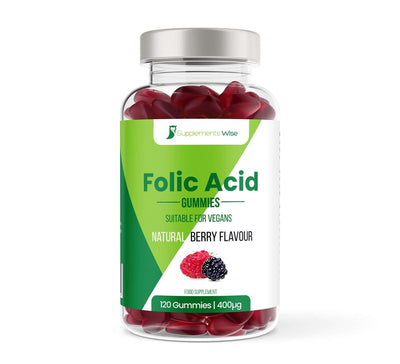
Top pickMade in the UK · GMP certified
Folic Acid Gummies 400mcg | 120 Berry Flavour Gummies
120 pectin gummies · 4-month supply at 1 per day
- Exact NHS 400mcg dose the Cochrane review used, no rounding
- Pectin-based chewable format, easier on early morning sickness than tablets
- One 120-gummy bottle covers the full preconception-to-week-12 window
Vegan · 30-day returns · Free UK shipping
In this article
- Which form should you actually take?
- What is folic acid, and how does your body use it?
- What is methylfolate (5-MTHF), and why is it different?
- What is the MTHFR gene, and does it actually matter?
- What does NHS and NICE guidance actually say?
- What does the research actually show?
- How do folic acid and methylfolate compare side by side?
- What doses match UK guidance?
- When should you choose 5-MTHF over folic acid?
- How should you take folate day to day?
- What happens beyond week 12?
- What are the common UK buyer mistakes to avoid?
- Frequently asked questions
Which form should you actually take?
When weighing methylfolate vs folic acid, remember that both meet NHS folate targets safely, so choose the form that best suits your genetics, budget, and personal preference.
If you have no special risk factors and you want to follow standard NHS advice, plain folic acid 400mcg daily is the most evidence-backed choice. It has decades of randomised trial data behind it for preventing neural tube defects, and it works in the vast majority of women.
If you have a confirmed MTHFR variant, a previous baby with spina bifida or anencephaly, or you simply want the form that needs no liver conversion, methylfolate 400 to 800mcg daily is a sensible swap. UKTIS confirms exposure to methylfolate in pregnancy is not regarded as harmful, though formal RCT data is thinner than for folic acid.
What is folic acid, and how does your body use it?
Folic acid is the synthetic form of vitamin B9 used in supplements and food fortification. Your body converts it through two enzyme steps in the liver, ending as 5-methyltetrahydrofolate (5-MTHF), the active form your cells actually use.
This is the form that has been studied in every major neural tube defect prevention trial since the 1991 MRC Vitamin Study. UK guidance gravitates to folic acid because the public health evidence base for preventing spina bifida and anencephaly is built on it.
Made in the UK · GMP certified
Folic Acid Gummies 400mcg | 120 Berry Flavour Gummies
120 pectin gummies · 4-month supply at 1 per day
- 400mcg per gummy, the NHS-aligned preconception dose in a chewable format
- Same active ingredient as every neural tube defect prevention trial since 1991
- Natural berry flavour, no tablet aftertaste that can trigger morning sickness
Vegan · 30-day returns · Free UK shipping
What is methylfolate (5-MTHF), and why is it different?
Methylfolate is the same active molecule your liver produces from folic acid, sold pre-converted. Supplements typically list it as (6S)-5-methyltetrahydrofolic acid or under the branded form Quatrefolic, both bioidentical to what circulates in your blood.
Because it skips the conversion step, methylfolate raises blood folate levels in women who carry the common MTHFR C677T variant. A 2013 review in Nutrients concluded 5-MTHF is a "promising alternative" to folic acid and behaves equivalently in healthy women (Obeid et al., 2013, DOI: 10.3390/nu5093481).
What is the MTHFR gene, and does it actually matter?
MTHFR is the gene that codes for the final enzyme in folate activation. The C677T variant slows that enzyme by about 30 to 70 percent depending on whether you carry one copy or two.
Around 10 to 12 percent of UK adults are homozygous (TT) for this variant, and roughly half the population carries at least one copy. That sounds dramatic, but most carriers metabolise enough folic acid to maintain a normal red blood cell folate when intake is adequate.
The clinically relevant question is not whether you carry the gene, but whether your folate status is low. NICE does not currently recommend routine MTHFR testing before pregnancy in the UK.
What does NHS and NICE guidance actually say?
The NHS recommends 400mcg of folic acid daily from preconception until the end of week 12 of pregnancy. The advice is form-agnostic in practice but written around folic acid because that is what the prevention evidence covers.
The UK Teratology Information Service (UKTIS) confirms methylfolate exposure in pregnancy is not regarded as harmful and would not warrant additional fetal monitoring. UKTIS does not, however, currently recommend methylfolate over folic acid as a first-line option for the general population.
A 5mg daily dose is reserved for higher-risk women, prescribed under NHS care rather than bought over the counter.
What does the research actually show?
What the Research Says
A Cochrane review of five randomised trials covering 6,105 women found periconceptional folic acid supplementation reduced neural tube defects by 69 percent compared with placebo, a huge protective effect (De-Regil et al., 2015, DOI: 10.1002/14651858.CD007950.pub3).
The Cochrane data is what justifies the standard 400mcg folic acid recommendation, and it is the reason UK public health bodies have not switched messaging to methylfolate. No comparably large RCT has yet been completed for 5-MTHF and neural tube defect prevention.
Smaller studies do show methylfolate raises red blood cell folate just as well as folic acid in healthy women, and slightly better in those with the TT MTHFR variant. A 2014 randomised trial in 144 reproductive-age women, including MTHFR 677TT carriers, found 5-MTHF significantly increased red blood cell folate compared with folic acid (Henderson et al., 2018, DOI: 10.3390/nu10101552).
How do folic acid and methylfolate compare side by side?
A common question is whether methylfolate is the same as folic acid, and the answer is no: both deliver folate, but methylfolate is the already-active form your body uses directly.
| Feature | Folic Acid | Methylfolate (5-MTHF) |
|---|---|---|
| Form | Synthetic, needs liver conversion | Pre-activated bioidentical folate |
| NHS recommendation | First-line, 400mcg daily | Not first-line, but accepted |
| Evidence base | Multiple large RCTs, Cochrane review | Smaller bioequivalence studies |
| Useful if MTHFR TT carrier | Works but conversion is slower | Bypasses the conversion bottleneck |
| Risk of unmetabolised folate | Possible at very high doses | Negligible at standard doses |
| Cost in the UK | Cheapest option, widely stocked | Slightly more expensive per serving |
| Best for most women | Yes, if no special factors apply | Reasonable if you prefer the active form |
What doses match UK guidance?
Most UK pregnancies need the same baseline dose, regardless of which form you choose. The exception is high-risk groups, where a much larger prescribed dose applies.
| Situation | Recommended Daily Dose | Source |
|---|---|---|
| Preconception and weeks 1 to 12 | 400mcg folic acid or 400 to 600mcg methylfolate | NHS, NICE |
| Previous NTD pregnancy | 5mg folic acid (prescription only) | NHS, NICE |
| Diabetes, BMI over 30, antiepileptics | 5mg folic acid (prescription only) | NHS, NICE |
| Confirmed MTHFR TT, no other risk | 400 to 800mcg methylfolate, optional | Discuss with GP or midwife |
| Weeks 13 onwards | Optional continuation at 400mcg | NHS, RCOG |
When should you choose 5-MTHF over folic acid?
For most women, the cheaper folic acid option is sensible and adequate. There are three buyer scenarios where switching to methylfolate is worth considering.
If you have a confirmed MTHFR variant
If a private blood test or family history has confirmed the C677T TT or A1298C CC variant, methylfolate skips the conversion step your enzyme handles poorly. A 2018 study in 144 women found 5-MTHF lifted red cell folate higher than folic acid in TT carriers (Henderson et al., 2018, DOI: 10.3390/nu10101552).
This does not mean folic acid is dangerous if you carry the variant. It means methylfolate may reach therapeutic blood levels faster.
If high-dose folic acid upsets your stomach
Some women take a 5mg prescribed dose for diabetes or high BMI and find it causes nausea, bloating, or a metallic taste. Switching the over-the-counter component to methylfolate, while keeping the prescribed folic acid, is a small change worth raising with your midwife.
Do not stop a 5mg prescription without medical advice. The high-dose recommendation exists because the risk of neural tube defects in your specific situation is meaningfully elevated.
If you already take a methylated B-complex
Pre-pregnancy supplement routines for fertility, energy, or homocysteine support often include a methylated B-complex containing 5-MTHF plus methylcobalamin. Adding plain folic acid on top is rarely harmful but can be redundant.
Check the label of your existing supplement before adding anything. If it already lists 400mcg or more of 5-MTHF, you are likely covered.
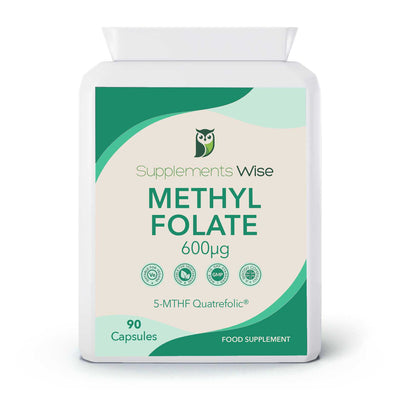
Made in the UK · GMP certified
Methyl Folate 5-MTHF 600mcg with Quatrefolic | 90 Vegan Capsules
90 vegan capsules · 3-month supply at 1 per day
- Patented Quatrefolic (6S)-5-MTHF, bioidentical to what your blood already carries
- 600mcg per capsule (300% NRV), skips the MTHFR conversion bottleneck
- Plant-based HPMC capsule, one a day covers the preconception window
Vegan · 30-day returns · Free UK shipping
How should you take folate day to day?
Both folic acid and methylfolate are water-soluble and absorbed efficiently with or without food. Many women take them with breakfast to anchor the habit.
If you experience early morning sickness, a small snack with folic acid gummies after lunch tends to be better tolerated. Consistency matters more than timing, because the goal is steady red cell folate over the months around conception.
Pair either form with a dietary pattern rich in leafy greens, beans, eggs, and fortified UK breakfast cereals. Supplements close the gap, but real food still does the heavy lifting for overall pregnancy nutrition. For broader pregnancy supplement context, see our Pregnancy and Postnatal Supplements Guide.
Worth Knowing
Routine MTHFR testing is not recommended by NICE before pregnancy in the UK. If you do choose private testing, interpret the result with a doctor or registered nutritionist before making large dose changes. Carrying the variant alone is not a diagnosis.
What happens beyond week 12?
The 12-week window matters because that is when neural tube closure is complete. After that, folate is still essential for cell division, red blood cell production, and placental growth.
Many UK midwives suggest continuing 400mcg in some form throughout pregnancy and breastfeeding. NHS guidance does not mandate it, but the wider pregnancy multivitamin packs sold in UK pharmacies almost always include folate at this dose for that reason.
If you switch to a multivitamin at week 13, check the label so you do not double up unnecessarily. For information on other key pregnancy nutrients, see our Vitamin D in Pregnancy guide.
What are the common UK buyer mistakes to avoid?
Buying a "high strength" 5mg folic acid over the counter without a prescription is a frequent slip. The 5mg dose is meant for women with specific risk factors and should be issued by a GP, not self-selected.
The opposite mistake is also common, where women stop folic acid at the moment they get a positive pregnancy test. Neural tube closure happens in weeks five to seven, often before women realise they are pregnant, which is why preconception use matters.
Finally, expensive prenatal multivitamins are not automatically better than a basic folate tablet plus a balanced diet. The form and the dose are what counts, not the price tag.
Key Takeaway
Folic acid 400mcg remains the NHS first-line option for preconception and the first trimester, backed by Cochrane-level evidence. Methylfolate 400 to 800mcg is a reasonable alternative for MTHFR carriers, women on a methylated B-complex, or anyone who prefers the bioactive form. Both work, and consistency for the three months before conception matters more than the brand on the bottle.
Frequently asked questions
Is methylfolate better than folic acid in pregnancy?
Methylfolate is not officially endorsed as superior in UK guidance, because the large neural tube defect prevention trials used folic acid. It is a reasonable alternative for MTHFR carriers, women on methylated B-complexes, or those who prefer the pre-activated form. For most women without risk factors, folic acid 400mcg remains the simpler and cheaper first-line choice.
Can I take methylfolate instead of folic acid while pregnant?
Yes, methylfolate at 400 to 600mcg daily is regarded as a safe alternative in UK pregnancy, according to UKTIS. It raises red blood cell folate effectively and is particularly useful if you carry an MTHFR variant. You should not, however, replace a 5mg prescribed folic acid dose with methylfolate without speaking to your GP or midwife first.
Is 5-MTHF safe in pregnancy?
Yes, 5-MTHF is the same active form your body produces from folic acid, and UKTIS confirms exposure during pregnancy is not regarded as harmful. Standard doses of 400 to 800mcg fall well within tolerable intake limits for folate. Always tell your midwife which supplements you are taking so they can advise on your specific risk factors.
How much methylfolate should I take in pregnancy?
The most commonly used pregnancy doses are 400, 600, or 800mcg of 5-MTHF daily, mirroring the 400mcg folic acid baseline. If you have a confirmed MTHFR TT variant, 600 to 800mcg is often suggested in private practice. Anything higher should be discussed with your healthcare provider, particularly if you have specific risk factors.
Should I get tested for MTHFR before pregnancy?
NICE does not recommend routine MTHFR testing for women planning pregnancy in the UK. Carrying the C677T or A1298C variants is common, and most carriers maintain adequate folate status on standard supplementation. Testing may be considered after recurrent miscarriage or a previous NTD pregnancy, but always alongside specialist guidance.
Does folic acid cause harm if I cannot convert it well?
At the standard 400mcg dose, folic acid is regarded as safe even in slow converters and the protective effect on neural tube defects is preserved. Theoretical concerns about unmetabolised folic acid relate to chronic intake well above the UK upper limit of 1mg from supplements. If you take prescribed 5mg under medical supervision, the benefit is judged to outweigh any unmetabolised folate concern.
When should I start taking folate for pregnancy?
The NHS recommends starting folic acid as soon as you stop contraception or actively try to conceive, ideally at least three months before pregnancy. This applies equally to methylfolate if you choose that form. Continue at the same dose until at least the end of week 12, when the neural tube has closed.
The honest bottom line on folate in UK pregnancy is that the form matters less than the consistency. Folic acid 400mcg is the cheapest and most evidence-backed route, and methylfolate 600mcg is the bioactive alternative for MTHFR carriers or women already on a methylated B-complex.
Pick one, take it from at least three months before conception through the end of week 12, and tell your midwife what you are using.
Start the 12-week folate routine
400mcg folic acid in a chewable berry-flavour gummy, one a day for a 4-month supply.
UK GMP-certified · Vegan · 30-day returns · Free UK shipping
Carrying an MTHFR variant or prefer the active form?
600mcg Quatrefolic 5-MTHF that bypasses the MTHFR conversion step entirely.
Shop Methyl Folate 5-MTHF £13.95This article is for information only and is not medical advice. Food supplements should not replace a varied diet or a healthy lifestyle. Speak to your GP or pharmacist before starting any new supplement, especially if you are pregnant, breastfeeding, taking medication or managing a health condition.