How Long Does Ashwagandha Take to Work? A UK Week-by-Week Timeline

Most healthy UK adults will not feel much in the first fortnight on ashwagandha. Stress and anxiety scores usually shift between weeks 4 and 8 on 300 to 600 mg per day of a standardised extract, per the Chandrasekhar 2012 and Salve 2019 randomised trials. Sleep quality tends to improve between weeks 6 and 10.
Strength, testosterone and fertility endpoints in men take a full 8 to 12 weeks. Cortisol drops appear on blood tests around day 60. If you are looking for a same-day effect, you are looking at the wrong supplement.
If you are willing to commit to a 12-week trial with a decent dose and a sensible routine, the human evidence is genuinely reasonable, especially for stress, sleep and strength.
This UK guide walks through the week-by-week timeline for each endpoint the trials measured, explains why gummies and capsules feel different, covers what to do if you feel nothing at week 4, and flags the point at which another bottle stops being the answer and a GP appointment does. Written for UK adults 25 to 65 considering their first bottle, or already three weeks in and wondering whether to keep going.
Key Takeaway
Ashwagandha is not a same-day calmer. Give it 8 weeks at 300 to 600 mg per day of a standardised extract before you judge it. Most trials that showed real effects ran for 60 to 90 days.
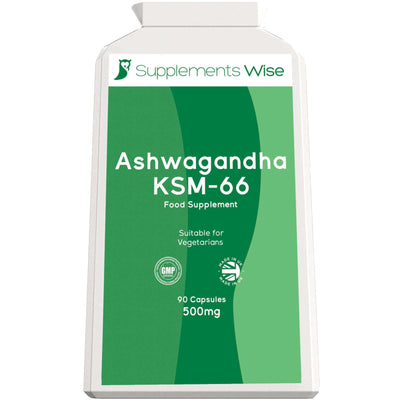
Made in the UK · GMP certified
Ashwagandha KSM-66 Capsules 500mg
90 vegetarian capsules · 3-month supply
- 500mg standardised KSM-66 root extract per capsule
- Trial-grade dose used across Chandrasekhar 2012 and Salve 2019
- One capsule a day covers a full 12-week evidence trial
Vegetarian · 30-day returns · Free UK shipping
In this article
- How does ashwagandha actually work in the body?
- What happens in the first 1 to 2 weeks?
- When should you notice stress and anxiety relief?
- How long until you sleep better on ashwagandha?
- When do testosterone and strength effects show?
- How long until cortisol actually drops?
- Do ashwagandha gummies work as fast as capsules?
- What if you feel nothing after 4 weeks?
- Which ashwagandha extracts deliver fastest?
- How long should you actually stay on ashwagandha?
- When should you see a GP instead of buying another bottle?
- Frequently asked questions
How does ashwagandha actually work in the body?
Ashwagandha (Withania somnifera) is an adaptogen. Its active molecules are withanolides, standardised in most quality extracts to roughly 5 percent by weight.
The best-supported mechanism is on the hypothalamic-pituitary-adrenal (HPA) axis, the biological chain that produces cortisol when the brain perceives stress. Chronic dosing appears to dampen HPA reactivity, which is why serum cortisol falls on trial bloods and why perceived-stress scores follow it down.
Secondary mechanisms include GABA-mimetic activity (probably part of the sleep effect), mild thyroid stimulation, and modest anabolic effects at higher doses in resistance-trained men. Because the effect is regulatory rather than agonist, nothing happens after a single capsule. The system needs several weeks of consistent dosing to shift baseline.
What happens in the first 1 to 2 weeks?
Honestly, not much. Some people report a subtle "calmer edge" or slightly deeper sleep in week 1, but this is not distinguishable from placebo in blinded trials at that timepoint.
A few people notice mild stomach upset or drowsiness in the first few days. This usually settles by the second week. If it does not, splitting the dose (half in the morning, half after dinner) or moving it to bedtime with food tends to fix it.
Do not judge ashwagandha at 2 weeks. Almost every trial that measured a meaningful effect ran for 8 weeks or longer. If your reference point is caffeine or magnesium (where you feel something the same day), reset expectations before you write it off.
When should you notice stress and anxiety relief?
The landmark UK-relevant trial is Chandrasekhar 2012, which randomised 64 adults with a history of chronic stress to KSM-66 ashwagandha 300 mg twice daily or placebo for 60 days. The active group saw perceived-stress scores fall by about 44 percent, versus about 5 percent for placebo. Serum cortisol dropped by roughly 27 percent (Chandrasekhar et al., 2012, DOI: 10.4103/0253-7176.106022).
Salve 2019 tested KSM-66 at both 250 mg and 600 mg per day for 8 weeks in 60 adults with self-reported stress. Both doses beat placebo on the Perceived Stress Scale by week 4, with 600 mg producing the larger effect (Salve et al., 2019, DOI: 10.7759/cureus.6466).
For most UK buyers, this means expect the first genuine stress or anxiety shift somewhere between week 4 and week 8 at 300 to 600 mg per day of a standardised extract. If you specifically care about anxiety, the timeline is similar but the effect size is generally smaller than for perceived stress.
What the Research Says
Chandrasekhar 2012 remains the most-cited ashwagandha trial in the world. In 64 UK-comparable adults with a documented stress history, KSM-66 root extract 300 mg twice daily for 60 days cut perceived-stress scores by 44 percent versus a 5 percent placebo change, alongside a 27 percent drop in serum cortisol. The trial ran for 60 days for a reason. Nobody claimed a shorter timeline (Chandrasekhar et al., 2012, DOI: 10.4103/0253-7176.106022).
How long until you sleep better on ashwagandha?
Langade 2019 ran a 10-week randomised trial in 80 adults with insomnia or non-restorative sleep. KSM-66 300 mg twice daily improved the Pittsburgh Sleep Quality Index, sleep-onset latency and total sleep time versus placebo, with the biggest gains in the insomnia sub-group (Langade et al., 2019, DOI: 10.7759/cureus.5797).
Users tend to feel a subjective "settled evening" starting around week 3, but the objective sleep-quality improvements landed by week 6 to week 10 in the trial. If you specifically want ashwagandha for sleep, take it after dinner rather than in the morning, and give it 8 to 10 weeks before scoring it.
Note that ashwagandha is not a sedative and it does not knock you out. If you need to fall asleep in the next 20 minutes, that is a different conversation, and generally not a UK supplement one.
See our related guides on the best time to take ashwagandha and magnesium timing.
When do testosterone and strength effects show?
Wankhede 2015 randomised 57 resistance-trained men to KSM-66 300 mg twice daily or placebo for 8 weeks alongside a supervised training programme. The active group added more bench-press and leg-extension strength and gained more arm-muscle cross-sectional area, with a modest serum testosterone rise, versus training-only controls (Wankhede et al., 2015, DOI: 10.1186/s12970-015-0104-9).
Ambiye 2013 tested a higher dose (675 mg per day for 90 days) in 46 men with oligospermic infertility and found sperm-count and serum-testosterone improvements at day 90 (Ambiye et al., 2013, DOI: 10.1155/2013/571420).
For strength and body-composition changes, expect a real signal at 8 weeks alongside actual training. Without lifting, ashwagandha will not build muscle.
For testosterone as an endpoint on its own, 12 weeks at a decent dose is the honest floor. Anyone marketing ashwagandha as a same-week testosterone booster is selling you a story the trials do not support.
How long until cortisol actually drops?
The Chandrasekhar 2012 27-percent cortisol drop was measured at day 60. Salve 2019 showed cortisol changes at 8 weeks. There is no reliable UK evidence that ashwagandha shifts blood cortisol before 4 weeks, and no reason to expect it to.
Cortisol is a moving target on a normal day, following a strong diurnal rhythm (highest in the morning, lowest around midnight). If you want to prove to yourself that ashwagandha is doing something on your bloods, test morning fasting cortisol before you start, and again at day 60. Do not test at day 14 and conclude anything.
A more useful in-the-moment signal is the Perceived Stress Scale, a free 10-item questionnaire NHS talking therapies sometimes use. Score yourself at day 0 and at day 60. If the number has not moved by day 60, ashwagandha is probably not the right lever for your stress profile.
Do ashwagandha gummies work as fast as capsules?
Roughly yes, if the dose per day matches. Withanolides are the active fraction and it does not matter whether they arrive via capsule or gummy, as long as the daily standardised extract dose is comparable. What matters far more than format is whether the product is standardised and whether you actually take it every day for 8 weeks.
Gummies win on adherence for anyone who dislikes swallowing capsules or who forgets in the morning. They lose on sugar load (typical UK ashwagandha gummy = 2 to 3 g added sugar per daily serving) and per-mg cost. Capsules win on cost, sugar-free formulation and clinical-dose matching (most trials used 300 mg twice daily of KSM-66 root extract, easy to hit with a 500 mg cap once a day).
The Supplements Wise gummies deliver 1,200 mg of a 30:1 ashwagandha root extract per 2-gummy daily serving, standardised to 5 percent withanolides (about 60 mg withanolides per day). That is a therapeutic-range daily withanolide load and lines up with the doses used in the sleep and stress trials, just delivered from a different extract.
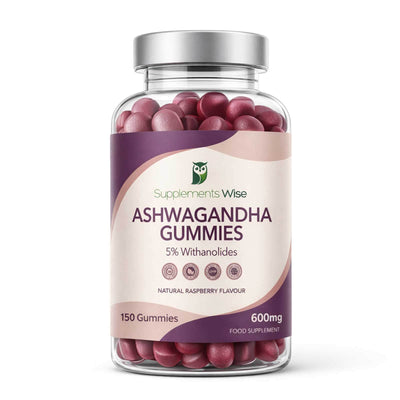
Made in the UK · GMP certified
150 vegan gummies · 75-day supply
- 1,200mg root extract per 2-gummy serving, 60mg withanolides
- Natural raspberry, pectin-based, no gelatin
- Therapeutic withanolide load without swallowing capsules
Vegan · 30-day returns · Free UK shipping
What if you feel nothing after 4 weeks?
Four weeks is early. Do not stop yet. First, sanity-check the four things that matter most:
| Check | What to look for | Fix |
|---|---|---|
| Extract type | Is the label a standardised extract (KSM-66, Sensoril) or bulk root powder? | Bulk powder needs 3 to 5 g per day, standardised extract 300 to 600 mg per day. |
| Daily dose | Are you actually at 300 to 600 mg per day? | Move to the higher end of the range. Salve 2019 showed 600 mg beat 250 mg. |
| Adherence | Are you missing more than 2 days a week? | Move the bottle next to the kettle. Ashwagandha is a chronic-dosing supplement, not an as-needed one. |
| Wrong endpoint | Buying it for a same-day calmer, a caffeine replacement or a mood lift? | Ashwagandha does not do those. Consider Magnesium Glycinate or the Brain Fog Supplements guide. |
Give it a full 8 weeks. If you have done the four checks above, held a decent daily dose, and still feel nothing on the Perceived Stress Scale or sleep quality, it is fair to conclude ashwagandha is not your responder profile.
Roughly 20 to 30 percent of people in the KSM-66 trials were classified as non-responders. Not everybody wins with the same molecule.
Which ashwagandha extracts deliver fastest?
The trial evidence is dominated by two branded standardised extracts. KSM-66 (root only, 5 percent withanolides) is used in Chandrasekhar 2012, Salve 2019, Wankhede 2015, Choudhary 2017 and Langade 2019. Sensoril (root + leaf, higher withanolide concentration 10 percent) is used in a smaller but still credible evidence base.
Neither is meaningfully "faster" than the other in head-to-head data because the timeline is set by HPA-axis chronicity, not by the extract. A 5 percent standardised root extract at 600 mg per day matches almost every trial dose. Bulk unstandardised root powder is not comparable and generally needs a much higher gram-scale dose to hit the same withanolide load.
If a UK bottle does not tell you the extract type and the withanolide percentage on the label, it is not a trial-grade product. Treat "ashwagandha 1,000 mg" without standardisation as marketing weight, not therapeutic weight.
How long should you actually stay on ashwagandha?
The longest published double-blind RCTs run about 12 weeks and there is no strong RCT evidence for a required "cycling off" period. That said, our current recommendation is a 12-week trial, then a 2 to 4 week wash-out, then decide whether to continue.
There are three reasons for the wash-out. First, it lets you separate real supplement benefit from lifestyle drift (sleep, diet, sunlight, training) that may have improved in parallel. Second, the 2025 Phytotherapy Research safety review flagged rare hepatotoxicity cases in extended continuous use, and a wash-out is a pragmatic risk-management step (Diamond et al., 2025, DOI: 10.1002/ptr.70158).
Third, it gives your HPA axis a chance to recalibrate rather than depending on the supplement.
If the benefit was real, you will feel it fade during the wash-out and can restart with confidence. If it was not, you have saved yourself the money.
Worth Knowing
Stop ashwagandha and call your GP immediately if you develop yellowing of the eyes or skin, dark urine, unexplained abdominal pain or persistent nausea. These are signs of possible liver injury. Rare, but real. Do not take ashwagandha if you are pregnant, breastfeeding, have an active autoimmune condition (Hashimoto's, lupus, rheumatoid arthritis), take immunosuppressants, sedatives, thyroid hormone or lithium, or if you are under 18. See our fuller ashwagandha side effects UK guide.
When should you see a GP instead of buying another bottle?
Ashwagandha is a supplement, not a treatment. Some symptom patterns deserve a GP appointment first, and the bottle either after or never. Book a GP appointment if you experience any of the following:
Persistent low mood for 2 weeks or more, or thoughts of self-harm; new-onset severe anxiety with panic attacks; insomnia that has lasted more than a month and is affecting your ability to function; unexplained weight loss or fatigue alongside stress symptoms; palpitations, tremor or heat intolerance (possible thyroid symptoms); night sweats or fever alongside fatigue (possible infection or inflammation).
The NHS has free, confidential talking therapies that you can self-refer to for stress and anxiety. It has better evidence than any single supplement, and it is free at the point of use.
Ashwagandha is best positioned as an add-on to lifestyle work, not a substitute for it. NHS guidance on stress management covers the sleep, exercise and boundary-setting basics that shift the baseline more reliably than any capsule.
Key Takeaway
Ashwagandha works on a chronic-dosing timeline. Expect stress and anxiety shifts at 4 to 8 weeks, sleep quality at 6 to 10 weeks, strength and testosterone at 8 to 12 weeks. Take it every day at 300 to 600 mg of a standardised extract, and judge it at week 8, not week 2.
Frequently asked questions
Can you feel ashwagandha on the first day?
No, not reliably. Some people report a subtle "settled" feeling after their first dose, but this is not distinguishable from placebo in blinded trials. Ashwagandha works on the HPA axis over weeks, not on receptors within minutes.
How long does ashwagandha take to work for anxiety?
Between 4 and 8 weeks at 300 to 600 mg per day of a standardised extract in the trial data. The Perceived Stress Scale usually shifts before pure anxiety-scale scores. If you have panic disorder, a GP referral to NHS talking therapies is a better first step than a supplement.
How long do ashwagandha gummies take to work?
The same timeline as capsules, roughly 4 to 8 weeks for stress and 6 to 10 weeks for sleep, provided the gummies deliver a therapeutic daily withanolide load (around 25 to 60 mg per day). Format does not accelerate the biology.
Do you have to take ashwagandha every day for it to work?
Yes, near enough. The trials that showed effects all used daily continuous dosing, and missing 2 or more days a week is likely to blunt the result. It is a chronic-dosing supplement, not an as-needed one.
Should you take ashwagandha in the morning or at night?
Either works, and both were used in trials. Morning is convenient and helps with the daytime stress endpoint. Night suits people using it specifically for sleep, and splitting the dose (half morning, half evening) suits people prone to mild GI upset.
Is it safe to take ashwagandha for 12 weeks straight?
The published trials generally run to 8 to 12 weeks with a good tolerability profile. Longer continuous use has been linked to rare hepatotoxicity in case reports, so a 2 to 4 week wash-out after each 12-week block is a sensible risk-management step for adults using it long-term.
What if ashwagandha does not work for me at all?
Roughly 20 to 30 percent of trial participants classify as non-responders. If you have completed 8 weeks at 300 to 600 mg of a standardised extract, held the dose daily, and seen no shift in stress or sleep, the honest answer is it may not be your responder profile. Move to a different lever (talking therapy, magnesium, sleep hygiene, sunlight) rather than doubling the dose.
If you are ready to start, pick your format, commit to 8 weeks minimum and re-score yourself at day 60. The evidence is real, but it needs the timeline.
Start the sensible 12-week ashwagandha trial
KSM-66 500 mg per capsule, once a day, matches the trial-grade dose used across Chandrasekhar 2012 and Salve 2019. Ninety capsules cover a full evidence-length trial.
Shop Ashwagandha KSM-66UK GMP-certified · Vegetarian · 30-day returns · Free UK shipping
This article is for information only and is not medical advice. Food supplements should not replace a varied diet or a healthy lifestyle. Speak to your GP or pharmacist before starting any new supplement, especially if you are pregnant, breastfeeding, taking medication or managing a health condition.