Magnesium Glycinate Dosage: 5 UK Rules for Sleep and Stress

For most UK adults, the sweet spot for magnesium glycinate sits between 200 and 400mg of elemental magnesium per day, depending on your goal. A 2024 randomised controlled trial using bisglycinate specifically used 250mg taken nightly and showed significant gains in sleep quality, deep sleep and overall sleep efficiency over eight weeks of daily use.
The number on the front of the bottle is almost never the number you actually want. Most labels show total compound weight, while clinical doses are quoted in elemental magnesium, which is roughly 14 per cent of the compound in pure glycinate.
This guide gives you the dose by goal, the timing protocol, the UK safety ceiling, and the one label trick that stops you under-dosing. It links into our wider timing, safety and form-comparison guide where useful.
Key Takeaway
Most clinical trials showing benefits for sleep and anxiety used 200-400mg of elemental magnesium daily. The 2024 bisglycinate sleep RCT used 250mg. The UK Expert Group on Vitamins and Minerals advises a supplemental upper limit of 400mg elemental magnesium per day, so 500mg of glycinate from a label is fine because that is only around 70mg elemental. Take it with food, ideally 30 to 60 minutes before bed for sleep.
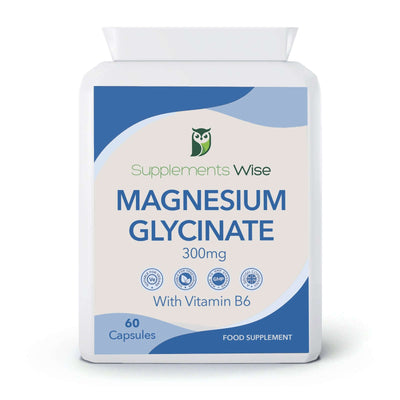
Made in the UK · GMP certified
Magnesium Glycinate with Vitamin B6
60 vegan capsules · 2-month supply
- 300mg elemental magnesium per serving
- Matches the 2024 bisglycinate sleep trial dose range
- Buffered bisglycinate, gentle on the gut
Vegan · 30-day returns · Free UK shipping
In this article
- How much magnesium glycinate should you take per day?
- Why does the label say 500mg when the dose is only 70mg?
- Why pick magnesium glycinate over other forms?
- What does the clinical evidence actually show?
- What is the right dose for sleep, stress, cramps or general health?
- When is the best time to take magnesium glycinate?
- Is 500mg of magnesium glycinate too much?
- What are the side effects and who should be cautious?
- How does magnesium glycinate compare to citrate, oxide and threonate?
- Frequently asked questions
How much magnesium glycinate should you take per day?
For most healthy UK adults, the practical range is 200 to 400mg of elemental magnesium per day from your supplement. That sits inside the UK Expert Group on Vitamins and Minerals guidance of up to 400mg elemental from supplements, and inside the range used in nearly every positive sleep and anxiety trial.
The right number for you inside that band depends on two things: how short your diet is on magnesium-rich foods, and what you are trying to fix. Sleep and stress doses tend to sit around 250 to 350mg, while general top-up doses are lower at around 200 to 250mg.
Start at the lower end for a week, then build up if you need to. The body absorbs magnesium more efficiently in smaller doses spread across the day, so splitting a 300mg target into a morning and evening serving often works better than one big hit.
Why does the label say 500mg when the dose is only 70mg?
This is the single most misread number in the supplement aisle. A label that says "magnesium glycinate 500mg" is quoting the total weight of the compound, not the amount of actual magnesium inside it.
Pure magnesium bisglycinate is roughly 14.1 per cent elemental magnesium by weight. A 500mg capsule of pure glycinate therefore delivers about 70mg of elemental magnesium, which is well under the dose used in any positive clinical trial.
This is why a lot of people quietly conclude that glycinate "does not work". They were comparing a 500mg label number against a 500mg magnesium oxide capsule, which delivers around 300mg elemental, and dosing four times lower without realising. Many UK formulas now use a buffered bisglycinate that blends in a small amount of oxide to lift the elemental content while keeping the gentle absorption profile.
Visting from outside the UK?
we don't ship internationally yet, but magnesium glycinate is widely available worldwide - find Magnesium Glycinate on iHerb.
How to read your UK supplement label
UK supplement labels are required to list elemental magnesium in the nutritional information panel, almost always followed by an NRV percentage. That is the number that matters.
If the panel says "Magnesium 300mg (80% NRV)", you are getting 300mg of elemental magnesium per serving. Ignore the big number on the front of the bottle and work from that one.
Why pick magnesium glycinate over other forms?
There are more than a dozen forms of magnesium on the shelf. Glycinate, also called bisglycinate, is magnesium bonded to two molecules of the amino acid glycine, and that chelated structure gives it two genuine advantages.
First, it is significantly gentler on the gut. Magnesium oxide and citrate can cause loose stools at higher doses, which is why a lot of people quietly drop them. Glycinate rarely does this even at the top of the clinical range.
Second, glycine itself has calming properties. It acts as an inhibitory neurotransmitter and may independently support relaxation and sleep quality, so you are getting a useful dual benefit from the mineral and its carrier molecule.
What the Research Says
The UK Expert Group on Vitamins and Minerals advises adults not to exceed 400mg of elemental magnesium per day from supplements. The European Food Safety Authority sets a more conservative tolerable upper level of 250mg per day. The UK NRV used on labels is 375mg per day from all sources, food included. The NHS magnesium guidance confirms these ceilings for healthy adults. All three figures refer to elemental magnesium, not compound weight on the front of the bottle.
What does the clinical evidence actually show?
The evidence base for magnesium and sleep has strengthened sharply in the last two years, and there is now a major trial that used bisglycinate specifically rather than older forms.
Magnesium bisglycinate for sleep (2024). A randomised, placebo-controlled trial in Nature and Science of Sleep tested bisglycinate in healthy adults reporting poor sleep, with participants taking 250mg of magnesium as bisglycinate plus glycine daily for eight weeks. The supplement group showed significant improvements in sleep quality, deep sleep, sleep efficiency and heart rate variability versus placebo (DOI: 10.2147/NSS.S524348).
Abbasi et al. (2012). A double-blind, placebo-controlled trial in the Journal of Research in Medical Sciences studied elderly adults with insomnia who took 500mg of magnesium daily for eight weeks. The magnesium group showed significant improvements in sleep time, sleep efficiency and melatonin levels (DOI: 10.5539/gjhs.v5n2p163).
Boyle et al. (2017). A systematic review in Nutrients examined magnesium supplementation and subjective anxiety. It found a positive trend for reducing anxiety, noting that study quality varied and more rigorous trials were needed (DOI: 10.3390/nu9050429).
Schiopu et al. (2022). A review in Nutrients focused on the absorption and bioavailability of magnesium bisglycinate, summarising why the chelated form is gentler on the gut and well-suited to sleep and stress dosing (DOI: 10.3390/nu14081567).
Clinical trial summary
| Study | Dose (elemental) | Form | Duration | Outcome |
|---|---|---|---|---|
| Bisglycinate RCT (2024) | 250mg | Bisglycinate | 8 weeks | Significant sleep improvements |
| Abbasi et al. (2012) | 500mg | Magnesium supplement | 8 weeks | Improved sleep time and efficiency |
| Boyle et al. (2017) | Various | Multiple (systematic review) | Various | Positive trend for anxiety reduction |
| Schiopu et al. (2022) | N/A (review) | Bisglycinate | N/A | Confirmed favourable absorption and gut tolerance |
The honest caveat is that most older studies used oxide or citrate. The 2024 bisglycinate RCT is the first major trial to demonstrate sleep benefits using the glycinate form specifically, which makes it the most directly relevant for anyone choosing this exact supplement.
What is the right dose for sleep, stress, cramps or general health?
If you're wondering how much magnesium glycinate for sleep specifically, the 2024 RCT's 250mg of elemental magnesium taken nightly is a sensible, evidence-based place to start.
The clinical evidence supports different doses for different goals, but all of them sit inside the same overall safety band. The table below maps the practical range to each common reason for taking magnesium glycinate.
| Goal | Daily elemental dose | Notes |
|---|---|---|
| General wellbeing top-up | 200 to 300mg | Tops up a typical UK diet towards the 375mg NRV |
| Sleep support | 250 to 400mg | 2024 bisglycinate trial used 250mg nightly |
| Stress and anxiety | 200 to 400mg | Start at 200mg, build up over two weeks |
| Muscle recovery | 300 to 400mg | Commonly paired with adequate protein and hydration |
| Leg cramps | 300 to 400mg | Evidence is mixed and may take several weeks |
If you are new to magnesium supplementation, start low and build up gradually over one to two weeks. This lets the body adjust and reduces any chance of a brief digestive settling-in period.
For a broader look at how magnesium supports overnight wind-down, see our guide to magnesium for restful sleep.
When is the best time to take magnesium glycinate?
For sleep, take your full dose 30 to 60 minutes before bed. That timing matches the protocol used in the 2024 bisglycinate trial and gives the glycine component time to support wind-down.
For general use, stress or muscle recovery, timing is less critical. Take it with a meal: that improves absorption and reduces any chance of stomach discomfort.
If you are taking 300mg or more, splitting into two doses (morning and evening) often works better than a single hit. The gut absorbs magnesium more efficiently in smaller amounts spread across the day.
Pair it with B6 if you can. Vitamin B6 supports magnesium absorption and utilisation, which is why many UK formulas, including ours, include B6. If yours does not, a B6-rich meal nearby (poultry, fish or potatoes) does a similar job.
Is 500mg of magnesium glycinate too much?
Almost always, no. A 500mg figure on a label usually refers to the compound, which delivers only about 70mg of elemental magnesium from pure glycinate. That is well under the UK 400mg supplemental ceiling.
The number that matters is the elemental magnesium line in the nutritional information panel. As long as that line stays at or under 400mg from supplements per day, you are inside UK guidance.
The picture changes if your product is a buffered glycinate-oxide blend, where 500mg of compound can deliver 200 to 300mg elemental. In that case, check the elemental line, add any other magnesium products you take, and stay under 400mg elemental from supplements per day.
What are the side effects and who should be cautious?
Glycinate has an excellent tolerability record at clinical doses. Loose stools are uncommon, and most reports of side effects come from very high doses or from people who already have other risk factors.
Worth Knowing
Kidney disease: the kidneys excrete excess magnesium, so impaired kidney function raises the risk of accumulation. Only supplement under medical supervision.
Blood pressure medication: magnesium can lower blood pressure modestly. If you take an antihypertensive, check with your GP before adding a daily supplement.
Antibiotics: magnesium can reduce absorption of tetracyclines and fluoroquinolones. Separate doses by at least two hours.
Pregnancy: magnesium is important during pregnancy, but doses above 400mg should only be taken on GP advice. The standard prenatal range is 300 to 360mg from all sources.
For most healthy adults, magnesium glycinate is well tolerated at recommended doses. If you do notice any digestive changes, drop back to a lower dose and rebuild over a week or two.
How does magnesium glycinate compare to citrate, oxide and threonate?
Different forms suit different goals. Glycinate is the best-evidenced choice for sleep, stress and sensitive stomachs, but it is not always the cheapest milligram-for-milligram option.
| Form | Elemental Mg | Best for | Drawback |
|---|---|---|---|
| Glycinate (bisglycinate) | ~14% | Sleep, anxiety, sensitive stomachs | Lower elemental per capsule unless buffered |
| Citrate | ~16% | General use, gentle constipation relief | Can cause loose stools at higher doses |
| Oxide | ~60% | Cost-effective NRV top-up | Lower absorption and more GI effects |
| Threonate | ~8% | Cognitive support (crosses the blood-brain barrier) | Expensive, very low elemental content |
If you want a higher elemental dose per capsule, our Magnesium Citrate 500mg capsules are a good cost-effective option. For broad-spectrum coverage, the Triple Magnesium Complex combines three forms in a single capsule. If you are new to supplements, our beginner's guide to supplements walks through the basics.
Frequently asked questions
How much magnesium glycinate should I take per day?
For most adults, 200 to 400mg of elemental magnesium per day from supplements covers the range used in nearly every positive sleep and anxiety trial. Sleep doses cluster around 250 to 350mg, while general top-up doses sit around 200 to 250mg. Always read the elemental line on the panel rather than the compound figure on the front.
Is 500mg of magnesium glycinate too much?
Usually not. A 500mg label figure normally refers to the compound, which from pure glycinate gives only about 70mg of elemental magnesium, well below the UK supplemental ceiling of 400mg. If the product is a buffered glycinate-oxide blend, check the elemental line in the nutritional panel and keep your total supplemental intake under 400mg per day.
How much glycinate per day is safe long term?
The UK Expert Group on Vitamins and Minerals advises that healthy adults can take up to 400mg of elemental magnesium per day from supplements on an ongoing basis. Clinical trials have used this range daily for eight weeks or more without significant adverse effects. If you take prescription medication or have kidney issues, check with your GP first.
Should I take magnesium glycinate in the morning or at night?
If you are taking it for sleep, take it 30 to 60 minutes before bed to match the timing used in the 2024 bisglycinate trial. For general supplementation or muscle recovery, timing matters less, so take it with any meal. If you split a higher dose into two servings, morning and evening is a sensible pattern for better absorption.
How long does magnesium glycinate take to work for sleep?
The 2024 bisglycinate trial measured outcomes at eight weeks, which is a reasonable timeframe to judge results. Some people notice improvements within one to two weeks, but magnesium status builds gradually. Consistency over several weeks matters more than the size of any single dose.
What is the difference between magnesium glycinate and bisglycinate?
They are the same thing. Bisglycinate is the technically precise name (one magnesium atom bonded to two glycine molecules), while glycinate is the common shorthand. Both deliver around 14.1 per cent elemental magnesium by weight in pure form.
How much magnesium glycinate should I take for anxiety?
Reviews suggest 200 to 400mg of elemental magnesium daily may support anxiety reduction. Start at 200mg and build up if needed, staying inside the 400mg supplemental ceiling. Glycinate is a particularly sensible choice because the glycine component has its own calming effect, and results typically emerge over several weeks of consistent daily use.
The bottom line is that magnesium glycinate is one of the better-evidenced sleep and stress supports on the UK shelf, as long as you dose by the elemental line rather than the compound number. Aim for 200 to 400mg elemental per day, take it with food (or before bed for sleep), and give it four to eight weeks.
Key Takeaway
Aim for 200 to 400mg of elemental magnesium per day from your supplement, sized to your goal. Read the elemental line on the panel, not the compound figure on the front. Take it 30 to 60 minutes before bed for sleep, or with food for everything else, and stay inside the UK 400mg supplemental ceiling.
Hit the Clinical Sleep Dose in One Capsule
300mg elemental magnesium from buffered bisglycinate, plus 5mg vitamin B6 for absorption. Matches the 2024 bisglycinate sleep trial range. UK GMP, vegan, 60 capsules per pack.
Shop Magnesium Glycinate + B6 at £9.95UK GMP-certified · Vegan · 30-day returns · Free UK shipping
This article is for information only and is not medical advice. Food supplements should not replace a varied diet or a healthy lifestyle. Speak to your GP or pharmacist before starting any new supplement, especially if you are pregnant, breastfeeding, taking medication or managing a health condition.