NMN vs NAD+: What’s the Difference?

NMN and NAD+ are not the same substance. NAD+ is a coenzyme your cells use for energy metabolism, DNA repair and other essential reactions, while NMN is a smaller precursor that the body can use to make NAD+.
This distinction explains why most oral products focus on NMN rather than supplying NAD+ itself. Taking NMN is an attempt to support the body's own NAD+ production, but an increase in blood NAD+ does not automatically prove better energy, slower ageing or a longer life.
Human trials show that oral NMN can raise measured NAD+ or related metabolites over periods ranging from weeks to months. However, the evidence for meaningful long-term health outcomes remains limited, and NMN should not be treated as a medicine or an anti-ageing guarantee.
Key Takeaway
NAD+ is the cellular coenzyme, while NMN is one of its building blocks. For an oral supplement, NMN is the more relevant comparison because it is studied as a precursor that the body converts through the NAD+ salvage pathway.
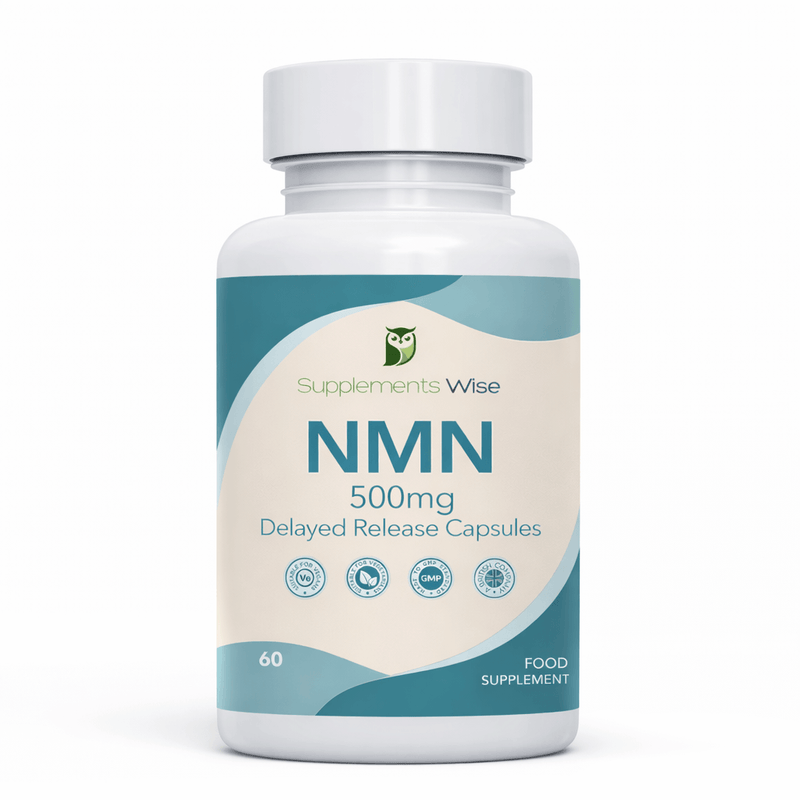
Made in the UK · GMP certified
NMN 500mg Delayed-Release Capsules
60 vegan capsules · 2-month supply
- 500mg beta-NMN per capsule
- One delayed-release capsule daily
- NMN is a direct NAD+ precursor
Vegan · 30-day returns · Free UK shipping
In this article
NMN vs NAD+ at a Glance
The simplest difference is precursor versus finished coenzyme. NMN stands for nicotinamide mononucleotide, while NAD+ stands for nicotinamide adenine dinucleotide in its oxidised form.
| Feature | NMN | NAD+ |
|---|---|---|
| Main role | Precursor used to make NAD+ | Coenzyme used in cellular reactions |
| Relationship | Upstream building block | Downstream product |
| Human oral evidence | Several small controlled trials | Less direct evidence for intact oral NAD+ |
| What labels may imply | Supports NAD+ production | Often marketed as direct NAD+ support |
The terms are sometimes placed together on packaging, which makes them look interchangeable. An NMN capsule does not contain NAD+, and a product labelled NAD+ should not be assumed to behave like the NMN doses studied in human trials.
What Is NAD+ and What Does It Do?
NAD+ is present in every living cell and participates in reactions that transfer electrons during energy metabolism. Cells continually cycle NAD+ into its reduced form, NADH, and back again as they process nutrients.
Energy metabolism
NAD+ accepts electrons during pathways that break down carbohydrate, fat and protein. This chemistry helps cells ultimately generate ATP, but taking a supplement is not equivalent to receiving an immediate stimulant effect.
DNA repair and signalling
NAD+ is also consumed by enzymes including sirtuins and poly(ADP-ribose) polymerases. These enzymes participate in cellular signalling and DNA-damage responses, which is one reason NAD+ metabolism attracts ageing research.
NAD+ concentrations can differ between tissues, and blood measurements do not describe every organ. Claims that one blood result represents whole-body cellular age should therefore be treated cautiously.
The plus sign describes the oxidised form that can accept electrons. After accepting electrons and a hydrogen, it becomes NADH, so NAD+ and NADH operate as a recycling pair rather than two unrelated nutrients.
What Is NMN?
NMN is a naturally occurring nucleotide made from nicotinamide, ribose and phosphate. It sits one biochemical step before NAD+ in an important recycling route known as the salvage pathway.
The body can produce NMN from other vitamin B3-related compounds, including nicotinamide riboside. NMN can then be converted to NAD+ by nicotinamide mononucleotide adenylyltransferase enzymes.
Why NMN is sold as a supplement
Researchers use precursor strategies because cells must constantly replenish NAD+. Oral NMN is intended to provide material for that replenishment process, rather than deliver the final coenzyme directly into every cell.
Our guide to choosing an NMN supplement in the UK explains beta-NMN, capsule format and label checks. Purity, dose and transparent manufacturing matter more than dramatic anti-ageing language.
How Does NMN Become NAD+?
NMN enters a network of transport and metabolic steps before contributing to NAD+ pools. The exact route can vary by tissue, and scientists continue to investigate how much intact NMN is transported versus first being converted into related compounds.
| Stage | What happens |
|---|---|
| 1. Intake | NMN is swallowed and passes through the digestive system. |
| 2. Absorption and processing | NMN or related metabolites enter circulation and tissues. |
| 3. Enzyme conversion | NMNAT enzymes add an adenylyl group to form NAD+. |
| 4. Cellular use | NAD+ supports redox reactions and is consumed by signalling enzymes. |
This is not a permanent conversion because NAD+ is continually used, recycled and broken down. A precursor supports a dynamic pool, not a storage tank that fills indefinitely.
Vitamin B3 from food also contributes to NAD+ metabolism through related routes. NMN supplementation adds one possible precursor source, but it does not replace an adequate diet or make the rest of the pathway irrelevant.
Oral NMN vs Oral NAD+: Which Makes More Sense?
NMN currently has the clearer human evidence base as an oral NAD+ precursor. Controlled trials have administered defined NMN doses and measured blood NAD+ or related metabolites, tolerability and selected clinical outcomes.
Intact NAD+ is a larger molecule, and oral products face digestion, absorption and cellular-entry questions. Some NAD-labelled products may contain precursors or use delivery claims that are not directly comparable with ordinary capsules, so check the complete ingredient list.
Intravenous NAD+ is a different intervention and should not be used to justify claims for an oral supplement. Route of administration changes exposure, cost and risk, and IV treatment belongs under qualified clinical supervision.
Sublingual sprays, patches and liposomal products introduce further formulation questions. Unless a finished product has been tested directly, claims about superior absorption remain product-specific marketing rather than a class-wide conclusion.
What Does Human NMN Research Show?
A randomised, double-blind trial of 30 healthy adults reported that oral NMN increased blood NAD+ concentrations during the study period and was well tolerated (Okabe et al., 2022, DOI: 10.3389/fnut.2022.868640). This supports the precursor mechanism, but the sample was small.
What the Research Says
A 60-day trial assigned 80 middle-aged adults to placebo or 300mg, 600mg or 900mg NMN daily. The study measured dose-related blood NAD+ changes, safety and selected physical outcomes, but it did not test lifespan (Yi et al., 2023, DOI: 10.1007/s11357-022-00705-1).
A separate controlled study in healthy older men used 250mg daily for six or twelve weeks and reported increased blood NAD+ metabolites with no significant deleterious effect during the trial (Igarashi et al., 2022, DOI: 10.1038/s41514-022-00084-z). Short-term tolerability is not the same as lifetime safety.
For timing and study schedules, see our guide to the best time to take NMN. Product instructions should still take priority over copying an isolated research dose.
Does Raising NAD+ Automatically Improve Health?
No, a biomarker change does not guarantee a noticeable or clinically important benefit. NAD+ is biologically essential, but increasing a measured concentration is only one link in a much longer chain between a supplement and health.
What has been measured
Trials have examined NAD+ metabolites, walking tests, insulin sensitivity, sleep measures and subjective outcomes. Results vary across populations, doses and study lengths, and many trials remain small or industry connected.
A 2024 meta-analysis of randomised trials found that evidence for glucose and lipid outcomes was not uniformly convincing (Chen et al., 2024, DOI: 10.1007/s11892-024-01557-z). That finding helps separate biochemical plausibility from proven treatment effects.
Animal research has generated many of the strongest longevity headlines, but doses, lifespans and disease models do not translate directly to healthy people. Human outcomes must be demonstrated in human trials, ideally with larger samples, independent replication and longer follow-up.
Our NMN timeline guide explains why subjective effects cannot confirm that NAD+ has risen. Energy, sleep and exercise performance have many competing influences.
How to Choose an NMN Supplement
Choose a clearly labelled beta-NMN dose from a traceable manufacturer. The label should state the amount per capsule, capsule count, serving direction, ingredients, suitability and relevant cautions.
Delayed-release formats are designed to move release beyond the stomach, although product-specific superiority requires direct comparative evidence. Avoid assuming that liposomal, sublingual or other premium terms guarantee better clinical results.
If you are comparing different precursors, read our NMN vs NR UK guide. You can also browse the wider longevity supplements collection without treating a multi-product stack as automatically better.
NMN Safety, Dosage and UK Cautions
Published human trials suggest short-term oral NMN is generally well tolerated at studied doses, but participant numbers and follow-up periods remain limited. Long-term effects, use during pregnancy and breastfeeding, and use in many medical conditions are not established.
Worth Knowing
Speak to a GP or pharmacist before taking NMN if you use regular medicines, have cancer or another significant condition, are pregnant or breastfeeding, or are awaiting surgery. Supplements should not delay investigation of persistent fatigue, weakness, weight change or other symptoms.
Do not combine several NAD+ products without checking duplicated ingredients and total doses. Stop use and seek advice if you experience an unexpected reaction.
Key Takeaway
NMN is the input and NAD+ is the cellular coenzyme produced downstream. Human studies support NMN's ability to influence NAD+ measures, while claims about reversing ageing or extending life remain ahead of the evidence.
Frequently Asked Questions
Is NMN the same as NAD+?
No, NMN is a precursor and NAD+ is a coenzyme. The body can use NMN in biochemical pathways that replenish cellular NAD+.
Does NMN contain NAD+?
A pure NMN capsule contains NMN rather than NAD+. Check the full label because combination products may contain other precursors or supporting ingredients.
Is NMN better than an NAD+ supplement?
NMN has a clearer body of controlled human research as an oral precursor. That does not prove every NMN product is effective or that all oral NAD+ formats are equivalent.
How long does NMN take to raise NAD+?
Blood changes have been measured within controlled study schedules, but the timing depends on the measurement, dose and individual. A laboratory change should not be confused with a guaranteed noticeable benefit.
Does NAD+ decline with age?
Research reports age-related changes in NAD+ metabolism, but patterns vary between tissues and individuals. Age alone does not establish that someone needs an NMN supplement.
Can NMN reverse ageing?
No human evidence shows that NMN reverses ageing. Trials have measured biomarkers and selected functions, not reversal of biological age or proven lifespan extension.
Can I take NMN with other supplements?
Check for duplicated ingredients and seek professional advice when medicines or health conditions are involved. Starting several products together also makes it harder to identify benefits or adverse effects.
Explore a Clearly Labelled NMN Precursor
Each delayed-release capsule provides 500mg beta-NMN, with one capsule daily giving a two-month supply.
Shop NMN 500mgUK GMP-certified · Vegan · 30-day returns · Free UK shipping
This article is for information only and is not medical advice. Food supplements should not replace a varied diet or a healthy lifestyle. Speak to your GP or pharmacist before starting any new supplement, especially if you are pregnant, breastfeeding, taking medication or managing a health condition.