Coenzyme Q10 300mg: A UK Evidence Guide to Dose, Heart Health and Statins

Coenzyme Q10 is a vitamin-like compound your cells use to turn food into usable energy, and a 300mg daily dose sits at the top of the range used in human research. The strongest single trial, Q-SYMBIO, found CoQ10 halved all-cause mortality in moderate-to-severe heart failure, and supporting trials at 300mg show measurable falls in oxidative stress and inflammation in heart patients on statins.
This guide is written for UK adults over 40 who are weighing up CoQ10, especially anyone on a statin, anyone with a family history of heart disease, or anyone who simply feels their energy and recovery are not what they were. It covers what CoQ10 actually does, why the dose matters, what the trials really show, and when to put the bottle down and speak to your GP first.
CoQ10 is not a cure for anything and it does not replace your prescribed medication. What it is, on the current evidence, is one of a small number of supplements with a real cardiovascular outcome trial behind it rather than mechanism and marketing alone.
Key Takeaway
CoQ10 powers the final step of cellular energy production, and tissue levels fall with age and with statin use. Research doses run from 100mg to 300mg daily, so a 300mg capsule covers the upper end. The evidence is strongest in people with heart conditions or on statins, so treat it as a targeted addition and clear it with your GP if you take prescription medication.
In this article
- What is CoQ10 and why does it matter for energy?
- Why does CoQ10 keep appearing in heart failure mortality data?
- Why 300mg, and where does the dose range come from?
- Should you take CoQ10 if you are on a statin?
- Does CoQ10 decline with age?
- Why pair CoQ10 with Vitamin B1?
- Ubiquinone or ubiquinol: which form should you choose?
- How and when should you take CoQ10 for best absorption?
- Who should talk to their GP before taking CoQ10?
- How does CoQ10 fit a wider heart and longevity routine?
- Frequently asked questions
What is CoQ10 and why does it matter for energy?
Coenzyme Q10, also written as CoQ10 or ubiquinone, is a fat-soluble compound found in almost every cell in the body. Its day job sits inside the mitochondria, the tiny power plants that convert the food you eat into adenosine triphosphate, the molecule that actually fuels muscle contraction, heartbeat and thought. Without CoQ10, the mitochondrial electron transport chain cannot complete the final steps of energy production.
Picture the electron transport chain as a bucket brigade passing electrons from one carrier to the next. CoQ10 is the mobile carrier that shuttles electrons between the early and late stages of that chain. The tissues with the highest energy demand, the heart, kidneys, liver and skeletal muscle, also hold the highest CoQ10 concentrations, which is why heart research dominates the literature.
CoQ10 has a second job as a fat-soluble antioxidant. It helps protect cell membranes and circulating lipids from oxidative damage, and it regenerates other antioxidants such as vitamin E. That dual role, energy carrier and membrane protector, is the mechanistic reason CoQ10 keeps being studied for ageing and cardiovascular health.
Why does CoQ10 keep appearing in heart failure mortality data?
Because of one of the better designed supplement trials in the entire literature. The Q-SYMBIO study randomised 420 patients with moderate-to-severe chronic heart failure to either CoQ10 100mg three times daily, totalling 300mg, or placebo, on top of their standard medication, and followed them for two years. The CoQ10 group had a 50 per cent lower rate of all-cause mortality and a 50 per cent lower rate of cardiovascular mortality than placebo (Mortensen et al., 2014, JACC Heart Failure, DOI: 10.1016/j.jchf.2014.06.008).
That result needs honest framing. Q-SYMBIO recruited people who already had significant heart failure, not healthy adults, so the headline figure cannot be transferred wholesale to someone simply wanting more energy. What it does establish is that CoQ10 at 300mg daily, on top of proper medical care, produced a hard clinical outcome rather than just a change on a lab printout.
The mechanism behind the result is general rather than disease-specific. A failing heart is an energy-starved heart, and CoQ10 supports the exact mitochondrial step that supplies that energy. That is why researchers continue to test it across cardiovascular and metabolic conditions.
What the Research Says
Q-SYMBIO was a randomised, double-blind, placebo-controlled, multicentre trial in 420 patients with moderate-to-severe heart failure. CoQ10 was dosed at 100mg three times daily (300mg total) for two years alongside standard therapy. The CoQ10 group showed a 50 per cent reduction in major adverse cardiovascular events and in all-cause mortality versus placebo, with no significant safety concerns (Mortensen et al., 2014, DOI: 10.1016/j.jchf.2014.06.008).
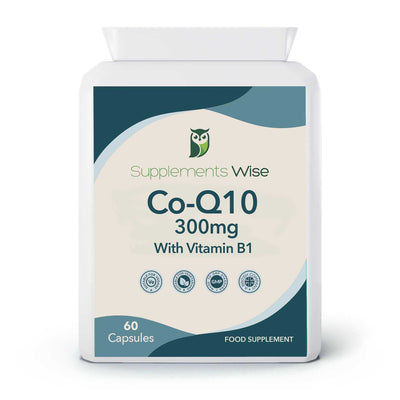
Co-Enzyme Q10 300mg, 60 Capsules, With Vitamin B1
300mg CoQ10 plus Vitamin B1 per capsule, the same total daily dose used in Q-SYMBIO, in a light-protective shell that shields the active from degradation. Vegan capsule, take with a fat-containing meal. 60-day supply.
UK GMP-certified · Vegan · 30-day returns · Free UK shipping
Why 300mg, and where does the dose range come from?
Most human CoQ10 trials use between 100mg and 300mg daily, and the cardiovascular trials cluster towards the higher end. A 300mg dose therefore covers the upper boundary of what has actually been tested in people, rather than the token 30mg to 50mg found in many cheaper products. Dose matters here because CoQ10 is a large, fat-soluble molecule with naturally limited absorption.
A separate randomised trial gave 300mg of CoQ10 daily for twelve weeks to coronary artery disease patients already taking statins. The CoQ10 group showed significantly higher antioxidant enzyme activity and lower inflammation than placebo, confirming that 300mg produces measurable biological change at the dose, not just in theory (Lee et al., 2013, Nutrition Journal, DOI: 10.1186/1475-2891-12-142).
There is a practical absorption point too. Because uptake plateaus, splitting a larger daily amount across meals, or simply taking it with the largest fatty meal of the day, helps more of it reach the bloodstream. The table below sets out where common doses fit.
| Daily dose | Typical use | Evidence context |
|---|---|---|
| 30 to 50mg | General wellness top-up | Below most trial doses |
| 100 to 200mg | Energy, statin support, general heart health | Lower end of the research range |
| 300mg | Cardiovascular focus, statin users, over 60s | Top of the research range (Q-SYMBIO, Lee 2013) |
| Above 300mg | Specialist, neurological research | Used in trials but rarely needed day to day |
Should you take CoQ10 if you are on a statin?
This is the single most common reason UK adults buy CoQ10, and it has a real rationale. Statins lower cholesterol by blocking the HMG-CoA reductase enzyme, but that same pathway also produces CoQ10, so statins measurably reduce circulating CoQ10 levels as a side effect. The open question has always been whether topping CoQ10 back up eases the muscle aches some statin users report.
A 2018 meta-analysis pooled twelve randomised controlled trials and found that CoQ10 supplementation significantly reduced statin-associated muscle symptoms, including pain, weakness, cramp and tiredness, compared with placebo (Qu et al., 2018, Journal of the American Heart Association, DOI: 10.1161/JAHA.118.009835). The effect was modest and not every trial agreed, but the direction was consistent enough to be worth knowing.
The sensible position is to try CoQ10 as an add-on, never as a replacement for your statin, and to tell your GP you are doing it. If statin muscle symptoms are genuinely limiting you, that is a conversation for your prescriber, not something to manage alone with a supplement.
Does CoQ10 decline with age?
Yes. The body makes most of its own CoQ10, but that internal production peaks in your twenties and then falls steadily. By your forties and fifties, tissue CoQ10 in the heart and other organs can be well below youthful levels, and diet contributes only small amounts because food sources such as oily fish, organ meats and nuts are modest.
This age-related decline is one reason CoQ10 features so often in longevity discussions. The logic is straightforward: an ageing cell with less CoQ10 is a cell with a slightly less efficient energy supply and slightly weaker antioxidant defence. Supplementing aims to narrow that gap.
It is worth being honest that no trial has shown CoQ10 extends human lifespan. What the evidence supports is a plausible role in healthspan, the years you stay active and well, particularly for the heart. For the wider picture of which longevity supplements have real trial data, see our UK longevity supplements evidence guide.
Why pair CoQ10 with Vitamin B1?
The Supplements Wise 300mg formula adds Vitamin B1, also called thiamine, at 0.165mg per capsule, which is 15 per cent of the daily reference intake. The pairing is deliberate, because thiamine and CoQ10 work on neighbouring steps of the same energy-production process. Thiamine is a cofactor for enzymes that feed fuel into the mitochondria, while CoQ10 carries the electrons that result.
Thiamine has an authorised role in normal energy-yielding metabolism and normal heart function under UK and EU nutrition rules, which CoQ10 alone does not. Adding a recognised energy-metabolism nutrient gives the formula a more complete approach to cellular energy rather than relying on CoQ10 in isolation.
The amount is modest by design. It is there to complement a balanced diet and support the energy pathway alongside the headline CoQ10 dose, not to act as a high-dose B-vitamin supplement in its own right.
Ubiquinone or ubiquinol: which form should you choose?
CoQ10 exists in two interchangeable forms. Ubiquinone is the oxidised, more stable form, and ubiquinol is the reduced, antioxidant-active form, and your body converts freely between the two as needed. Most research, including Q-SYMBIO, used standard ubiquinone, which is also the more shelf-stable and cost-effective option.
Ubiquinol is sometimes marketed as automatically superior because it is the active antioxidant form, and some studies suggest slightly better absorption in older adults with reduced conversion capacity. In practice, a healthy person converts ubiquinone to ubiquinol efficiently, and the trial that matters most for hard outcomes used ubiquinone at 300mg.
For the majority of UK adults, a well-dosed ubiquinone at 300mg is a sound, evidence-aligned choice. The dose and consistency of taking it daily matter far more than the form on the label. Protecting the molecule from light and oxygen, which the iron-oxide-coloured capsule shell is designed to do, also helps keep the active stable until you take it.
Worth Knowing
CoQ10 can interact with warfarin and similar anticoagulants because of its structural similarity to vitamin K, and it may mildly lower blood pressure. If you take warfarin, blood pressure medication, or diabetes medication, or are pregnant, breastfeeding or under 18, speak to your GP or pharmacist before starting CoQ10.
How and when should you take CoQ10 for best absorption?
CoQ10 is fat-soluble, so the single most useful habit is to take it with a meal that contains some fat. Taken on an empty stomach, absorption of this large molecule drops sharply, which wastes much of the dose. A breakfast with eggs, oily fish, nuts or full-fat yoghurt, or any main meal with oil or butter, all work well.
Timing across the day is flexible. Many people take CoQ10 in the morning with the largest cooked meal, while some prefer it with their evening meal. Consistency matters more than the exact hour, so pick a meal you rarely skip and attach the capsule to it.
Give it a fair trial of at least eight to twelve weeks. Blood and tissue CoQ10 rise over several weeks, and any change you notice in energy, exercise tolerance or statin-related aches builds gradually rather than overnight. Track one or two simple markers, such as how you feel on a regular walk, and judge it at the twelve-week mark.
Who should talk to their GP before taking CoQ10?
CoQ10 is well tolerated in trials, with side effects usually limited to mild digestive upset, but it is not right for everyone to start unsupervised. Book a conversation with your GP or pharmacist first if any of the following apply to you, because CoQ10 interacts with several common UK prescriptions.
| Likely a good fit | Talk to your GP first |
|---|---|
| Adults over 60 wanting cardiovascular support | Anyone taking warfarin or another anticoagulant |
| Statin users with mild muscle aches | Anyone on blood pressure or diabetes medication |
| A family history of heart disease, basics already in place | Pregnant, breastfeeding or under 18 |
- You take warfarin or another anticoagulant, as CoQ10 may reduce its effect.
- You take blood pressure medication, as CoQ10 can have a mild additive lowering effect.
- You take insulin or other diabetes medication, as blood sugar may shift slightly.
- You are undergoing chemotherapy, where antioxidant timing should be doctor-led.
- You are pregnant, breastfeeding or under 18, where safety data is limited.
- You have any new or worsening chest pain, breathlessness or palpitations, which need assessment, not a supplement.
None of this makes CoQ10 dangerous for the average healthy adult. It simply means that the people most likely to benefit, those on heart medication, are also the people who should loop in their prescriber before starting.
How does CoQ10 fit a wider heart and longevity routine?
CoQ10 works best as one targeted piece of a sensible routine, not a magic bullet. The foundations still come first: not smoking, regular movement, a blood pressure under control, sleep, and a Mediterranean-style diet do more for your heart than any capsule. CoQ10 earns its place as a focused addition once those basics are in hand, especially for statin users and the over 60s.
From there it pairs logically with the other evidence-graded staples. Omega-3 for cardiovascular and joint support, vitamin D for the long-term mortality signal covered in our vitamin D deficiency signs guide, and NMN for NAD+ and cellular energy as set out in our NMN UK guide. Each targets a different part of the ageing-energy picture.
The guiding principle is durability and focus. A modest, consistent routine you actually stay on for years will always beat a sprawling stack you abandon, so add CoQ10 for a clear reason, give it a full trial, and judge it on how you feel and on your bloods.
Key Takeaway
A 300mg CoQ10 dose matches the top of the research range and the amount used in the Q-SYMBIO mortality trial. It is most useful for statin users, the over 60s, and anyone with cardiovascular risk, taken with a fatty meal for twelve weeks. Keep the lifestyle basics first, clear it with your GP if you take prescription medication, and judge it on how you actually feel.
Frequently asked questions
Is 300mg of CoQ10 too much?
No, 300mg sits at the top of the range used in human research and was the total daily dose in the Q-SYMBIO heart failure trial. CoQ10 is well tolerated and doses up to 300mg and beyond have a good safety record in trials. If you take warfarin, blood pressure or diabetes medication, check with your GP before starting any dose.
How long does CoQ10 take to work?
Blood and tissue CoQ10 levels rise over several weeks rather than days. Most people give it eight to twelve weeks before judging any change in energy, exercise tolerance or statin-related muscle aches. Take it daily with a fatty meal and assess it at the twelve-week mark.
Can I take CoQ10 with my statin?
Many people do, because statins lower the body's own CoQ10 production and a 2018 meta-analysis found CoQ10 modestly reduced statin-related muscle symptoms. CoQ10 is an add-on and never a replacement for your statin. Tell your GP you are taking it so they can keep an eye on how you respond.
What is the difference between ubiquinone and ubiquinol?
Ubiquinone is the oxidised, stable form of CoQ10 and ubiquinol is the reduced, antioxidant-active form, and the body converts between them as needed. Most research, including Q-SYMBIO, used ubiquinone. For healthy adults a well-dosed ubiquinone is a sound choice, and the daily dose matters more than the form.
Why does this CoQ10 include Vitamin B1?
Vitamin B1, or thiamine, is a cofactor for enzymes that feed fuel into the mitochondria, the same energy system CoQ10 supports. Thiamine has an authorised role in normal energy-yielding metabolism and normal heart function. Pairing the two gives a more complete approach to cellular energy than CoQ10 alone.
Should I take CoQ10 in the morning or at night?
Either works, as long as you take it with a meal containing some fat to aid absorption. Many people choose the largest cooked meal of the day, whether that is breakfast or dinner. Consistency matters more than the exact time, so attach it to a meal you rarely skip.
Does CoQ10 actually help you live longer?
No supplement has been shown to extend human lifespan, and CoQ10 is no exception. What the Q-SYMBIO trial showed was a 50 per cent reduction in mortality specifically in moderate-to-severe heart failure patients on standard care. For healthy adults the realistic case is supporting healthspan and heart energy, not adding years.
The honest bottom line on CoQ10 in 2026 is that it is one of the few supplements with a genuine cardiovascular outcome trial behind it. A 300mg dose matches the research range, the case is strongest for statin users and older adults, and the lifestyle basics still do the heavy lifting. Used with that perspective, and cleared with your GP if you take medication, it is a sensible, evidence-aligned addition to a heart-focused routine.
CoQ10 at the dose the research used
300mg CoQ10 plus Vitamin B1 per capsule, in a light-protective vegan shell. Take one daily with a fatty meal and give it a full twelve-week trial. Buy more and save, down to £16.95 each.
Shop CoQ10 300mgUK GMP-certified · Vegan · 30-day returns · Free UK shipping
Building a wider heart and longevity routine?
Shop All SupplementsThis article is for information only and is not medical advice. Food supplements should not replace a varied diet or a healthy lifestyle. Speak to your GP or pharmacist before starting any new supplement, especially if you are pregnant, breastfeeding, taking medication or managing a health condition.