Trans-Resveratrol UK Guide: Dose, Timing and Who Actually Benefits

Trans-resveratrol is the one form of resveratrol worth swallowing. It is the isomer used in every human trial, it survives digestion better than its cis cousin, and unlike red wine (which delivers about 1 mg per glass at most) a properly standardised capsule can put 150 to 500 mg into you in a single dose. It is not a longevity miracle, and mixed human evidence means it deserves a more careful read than most of the internet gives it.
This guide covers the doses that actually appear in randomised UK-relevant trials, when to take it, who tends to benefit and who almost certainly does not, how it fits alongside NMN in a longevity stack, and the honest null findings that keep the topic from being tidy. Every claim is anchored to a specific human trial, not an in-vitro cell study or a mouse paper.
You will also see us name a couple of things trans-resveratrol will not do. If you have read that it reverses ageing, cures Alzheimer's or replaces statins, none of that survives the human data. The upside is real but narrow, which is exactly what makes it a sensible layer for a certain kind of buyer.
Key Takeaway
The sensible UK trans-resveratrol dose is 150 to 500 mg per day of the trans isomer, taken with a fatty meal. Evidence is strongest for insulin sensitivity in type 2 diabetes and modest cardiovascular markers (endothelial function, blood pressure) in adults with metabolic risk. Evidence is weak or null for healthy adults chasing "longevity" alone, so pair it with NMN and diet, not with hype.
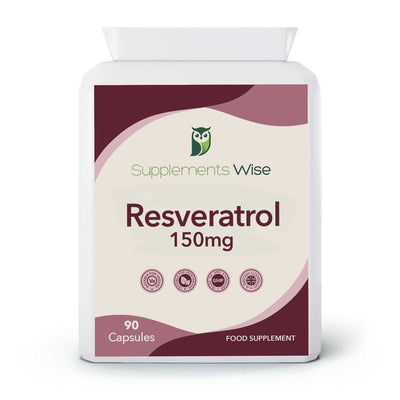
Made in the UK · GMP certified
Resveratrol Capsules 150mg 90 Trans-Resveratrol
90 vegan capsules · 90-day supply at 1 cap/day
- 150 mg trans-resveratrol from a 98% standardised Japanese knotweed extract, the isomer used in Timmers 2011 Cell Metab
- Trial-matched dose for the 30-day metabolic switch signal in obese men
- Pairs cleanly with NMN Complex for the Sinclair-style longevity stack
Vegan · 30-day returns · Free UK shipping
In this article
- What actually is trans-resveratrol?
- Why does the trans form matter so much?
- What dose has real UK-relevant human data?
- When should you take trans-resveratrol?
- What benefits actually hold up in humans?
- Where does the evidence go quiet or null?
- How does it pair with NMN in a longevity stack?
- Which resveratrol products should you skip?
- Who tends to benefit, and who probably will not?
- Is trans-resveratrol safe with medications?
- When should you check with your GP first?
- Frequently asked questions
What actually is trans-resveratrol?
Resveratrol is a stilbenoid polyphenol produced by plants under stress. Grapes, blueberries, peanuts and, most usefully for supplements, Japanese knotweed (Polygonum cuspidatum) all contain it. Japanese knotweed is the only common source with enough resveratrol to make standardised extraction economical, which is why almost every UK capsule on the market comes from it rather than grape skins.
The molecule exists in two geometric isomers, trans and cis. The trans form is the biologically active one used in every human clinical trial cited in this guide, and it is the isomer that survives gastrointestinal absorption in useful amounts.
Why does the trans form matter so much?
Cis-resveratrol is unstable, poorly absorbed, and rarely quantified on cheap own-brand labels. If a product just says "resveratrol 500 mg" with no isomer percentage, you have no idea what proportion is trans, and therefore no idea what dose you are actually taking.
The gold standard on a UK label is a Japanese knotweed extract standardised to 98% trans-resveratrol. That way a "150 mg" claim on the front of the bottle translates to about 147 mg of the active isomer inside each capsule, matching what appears in the Timmers 2011 trial we cite below. The same isomer logic applies to NMN, which we cover in our best NMN supplement UK guide.
What dose has real UK-relevant human data?
The three doses most commonly appearing in randomised human trials are 150 mg, 250 mg and 500 mg per day. Bhatt and colleagues gave 250 mg per day for three months to adults with type 2 diabetes and saw a 0.65 point drop in HbA1c and a 15 mmHg drop in systolic blood pressure compared with standard therapy alone (Bhatt et al., 2012, DOI: 10.1016/j.nutres.2012.06.003).
What the Research Says
Timmers and colleagues gave 150 mg per day of pure trans-resveratrol to 11 obese men for 30 days in a randomised crossover trial and saw meaningful shifts in metabolic health: lower systolic pressure, reduced liver fat on MRI, and gene-expression changes that mirrored calorie restriction. This is the trial that put the 150 mg dose on the map (Timmers et al., 2011, DOI: 10.1016/j.cmet.2011.10.002).
Above 1,000 mg per day the safety data thins out and gastrointestinal side effects rise. Most sensible UK stacks sit at 150 to 500 mg once daily, judged over three months, not three days.
When should you take trans-resveratrol?
Trans-resveratrol is fat-soluble, so take it with a meal that contains at least some fat. A capsule swallowed on an empty stomach in the morning absorbs at a small fraction of the rate of the same capsule taken alongside eggs, avocado, olive oil or oily fish.
Time of day matters less than the meal it rides in on. Some people prefer morning to fit alongside their NMN routine, others prefer with the largest meal of the day. Consistency is what generates the three-month trial-length signal, not clockwork precision, and we cover morning NMN routines in our best time to take NMN UK guide.
What benefits actually hold up in humans?
Four areas have the strongest human signal, and they are more specific than "anti-ageing" listicles suggest. Insulin sensitivity and HbA1c in type 2 diabetes shows the most consistent effect (Bhatt 2012, plus a 2015 meta-analysis of 11 RCTs by Liu and colleagues that pooled a 0.36 point HbA1c drop). Endothelial function improves at 250 to 500 mg daily in adults with metabolic risk (Wong et al., 2013, DOI: 10.1016/j.numecd.2011.03.006).
Systolic blood pressure drops modestly in the same audience, on the order of 4 to 5 mmHg. Liver fat on imaging reduces in obese men on 150 mg daily over 30 days per Timmers 2011, aligning with the mechanism we cover in our fatty liver UK evidence guide.
Where does the evidence go quiet or null?
The Semba group followed 783 older Italian adults in the Chianti region for nine years and found no association between dietary resveratrol intake and reduced mortality, cardiovascular disease or cancer (Semba et al., 2014, DOI: 10.1001/jamainternmed.2014.1582). That is dietary, not supplemental, but it is the largest observational reality check we have.
Healthy young adults with no metabolic dysfunction show minimal benefit in most trials. Weight loss claims do not hold up outside of the modest metabolic-marker shifts, and dementia prevention data is currently at the "interesting mechanism, no confirmed clinical benefit" stage.
How does it pair with NMN in a longevity stack?
NMN raises intracellular NAD+, and resveratrol activates SIRT1, one of the sirtuins that uses NAD+ as its fuel. Pairing the two is the reasoning behind the classic Sinclair-style stack we covered in our David Sinclair longevity stack UK guide, and it is why our NMN Complex ships with both molecules in one formula alongside quercetin and TMG.
For a modular stack, 150 mg trans-resveratrol taken with your NMN morning dose is the simplest pairing. If you would rather have the whole longevity stack in one capsule, our NMN Complex delivers 500 mg NMN, 600 mg TMG, 300 mg quercetin, 120 mg pterostilbene, 120 mg trans-resveratrol and 150 mcg methylcobalamin B12 per full three-capsule serving, which slots in with the wider longevity picture in our longevity supplements UK evidence guide. The Longevity Stack Bundle prices this pairing more efficiently again, though at the time of writing the bundle is out of stock and expected back on the site shortly.
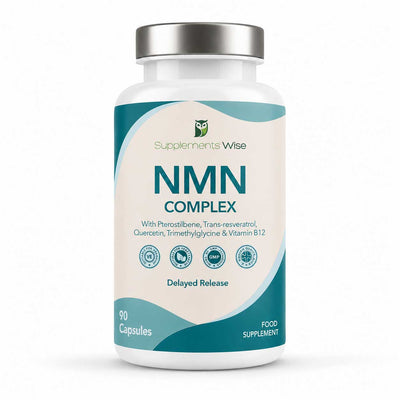
Made in the UK · GMP certified
NMN Complex with Resveratrol, TMG, Quercetin and Pterostilbene
90 delayed-release vegan capsules · 30-day supply at 3 caps/day
- 500 mg NMN plus 120 mg trans-resveratrol in one delayed-release serving
- Adds 600 mg TMG for methyl support, 300 mg quercetin and 120 mg pterostilbene
- The one-capsule version of the modular Sinclair stack described above
Vegan · 30-day returns · Free UK shipping
Which resveratrol products should you skip?
The resveratrol shelf is one of the messiest in the UK supplement aisle. The table below covers the recurring buyer traps and what to look for instead.
| Skip these | Why | Reach for instead |
|---|---|---|
| "Resveratrol 500 mg" with no isomer percentage | Could be 5% trans, could be 50%, could be 98%; you cannot dose what you cannot verify | A knotweed extract standardised to 98% trans-resveratrol on the label |
| Grape seed extract capsules sold as resveratrol | Grape seed extract is mostly proanthocyanidins; the resveratrol content is trace | A dedicated Japanese knotweed resveratrol product |
| Ultra-high-dose 1,500 mg + daily formulas | Above roughly 1,000 mg daily the GI side effects rise and no incremental benefit is documented in human RCTs | 150 to 500 mg once daily, sustained for at least 12 weeks |
| Red-wine-extract "anti-ageing" gummies at 5 to 25 mg | Below the trial-active dose by at least an order of magnitude; effectively a flavour | A trial-matched capsule at 150 mg or above |
| "Resveratrol wine" and functional drinks | A glass of red delivers about 1 mg trans-resveratrol; alcohol nets out negative on longevity markers | Non-alcoholic resveratrol capsule with a Mediterranean diet underneath |
Who tends to benefit, and who probably will not?
The strongest signal is in adults with existing metabolic dysfunction: type 2 diabetes, prediabetes, metabolic syndrome, non-alcoholic fatty liver disease, or a raised waist-to-height ratio with a family history of cardiovascular disease. Postmenopausal women and men in their 40s and 50s with mildly raised blood pressure are the classic "worth trialling" audience.
Healthy 25-year-olds with a good diet, an active lifestyle and no metabolic risk factors are unlikely to feel or measure anything. That is not a knock on the molecule; it is that trans-resveratrol nudges pathways that are already working well in that group.
Worth Knowing
Trans-resveratrol is not a substitute for prescribed medication. If you have type 2 diabetes or hypertension, keep taking your prescribed treatment and let your GP know before adding a supplement, since the dose adjustments can be meaningful in the small subset of responders.
Is trans-resveratrol safe with medications?
Trans-resveratrol is generally well tolerated at 150 to 500 mg daily. Doses above 1,000 mg raise the risk of nausea, cramping and loose stools. The clinically important interactions to know: it mildly inhibits CYP3A4 and CYP2C9, so plasma levels of some statins, warfarin, apixaban, rivaroxaban and certain calcium channel blockers can rise.
It should not be used alongside high-dose fish oil in anyone about to have surgery, because the additive antiplatelet effect could increase bleeding risk. Two-week gap before elective surgery, ideally under GP guidance.
When should you check with your GP first?
Book a GP conversation before starting resveratrol if you are on anticoagulants, chemotherapy, hormone-sensitive treatment, or if you are pregnant or breastfeeding. Same for anyone actively being investigated for gastrointestinal or liver symptoms, since a new supplement complicates the picture.
If you are outside those groups and want to trial it, do 12 to 16 weeks at a single dose, judge the result against a specific measurable target (fasting glucose, HbA1c, home blood pressure), and stop if there is no signal. That is a fairer test than swallowing a capsule and hoping to feel younger.
Frequently asked questions
Is trans-resveratrol the same as regular resveratrol?
Trans-resveratrol is the biologically active isomer used in every human clinical trial. Generic "resveratrol" without an isomer figure could contain very little trans, so the label needs to specify a standardised percentage.
How long before I notice anything on trans-resveratrol?
Metabolic markers move in 4 to 12 weeks in the responder trials, not days. Judge it at three months with a home blood pressure monitor, fasting glucose test or GP bloods rather than by how you feel.
Can I get enough resveratrol from red wine?
No. A glass of red wine contains about 1 mg trans-resveratrol, which is about 1% of a trial-active dose. To hit 150 mg from wine you would need roughly 150 glasses a day, and the alcohol would erase any benefit and then some.
Does trans-resveratrol help with weight loss?
Not directly. The metabolic-marker improvements in obese adults do not translate reliably to weight loss in the trial data. Losing 7 to 10% body weight through diet and activity remains the intervention with the biggest effect on the same markers.
Should I take trans-resveratrol with NMN?
Yes, they are mechanistically complementary: NMN raises NAD+, resveratrol activates SIRT1 which uses NAD+ as a substrate. Take both with a fatty morning meal, or use a combined formula like NMN Complex.
Is trans-resveratrol safe long term?
At 150 to 500 mg per day it is generally well tolerated across multi-month trials. Long-term safety data beyond two years is limited, so an annual break and a review of whether you still need it are sensible practice.
Can I take trans-resveratrol on statins?
Mention it to your GP or pharmacist first. Trans-resveratrol mildly inhibits CYP3A4, which can raise plasma levels of some statins (particularly simvastatin and atorvastatin) and increase side-effect risk.
Key Takeaway
Buy trans-resveratrol from a 98% standardised Japanese knotweed extract at 150 to 500 mg daily, take it with a fatty meal, judge it at three months against a measurable target, and skip anything sold as "red wine extract" or under 100 mg per capsule. Pair with NMN if the goal is a longevity stack rather than a single metabolic marker.
Start the sensible 12-week trans-resveratrol trial
Resveratrol Capsules 150 mg deliver the exact Timmers 2011 trial dose, from a 98% standardised Japanese knotweed extract, one capsule a day for a full 90-day supply. UK GMP-certified · Vegan · 30-day returns · Free UK shipping.
Shop Trans-Resveratrol 150 mgThis article is for information only and is not medical advice. Food supplements should not replace a varied diet or a healthy lifestyle. Speak to your GP or pharmacist before starting any new supplement, especially if you are pregnant, breastfeeding, taking medication or managing a health condition.