Turmeric and Ginger Benefits UK: A 2026 Evidence-First Guide

Turmeric and ginger are two of the most-searched supplements in the UK, and the pair is one of the most-hyped in health marketing. The honest answer is that the combination has real, trial-backed value for joint pain, everyday inflammation and (in ginger's case) nausea, but the "cure-all" claims that ride alongside it do not hold up.
This 2026 guide walks through what the peer-reviewed evidence actually says, the doses used in successful trials, and the specific claims worth ignoring. It is aimed at UK adults choosing between a tea, a gummy, a capsule or a fresh-root routine, and it flags the safety issues the marketing pages tend to skip.
You will get a straight answer on whether a UK-made turmeric and ginger gummy is worth £15.95 for two months, when a proper capsule with piperine is a better fit, and why one of these two ingredients has substantially stronger nausea evidence than the other.
Key Takeaway
Turmeric plus ginger has moderate evidence for knee osteoarthritis and everyday inflammation, and ginger on its own has strong evidence for nausea. Sensible daily doses are 500 to 1,000 mg of a standardised turmeric extract (delivering roughly 250 to 500 mg curcuminoids) with 250 to 1,000 mg of ginger, taken with food.
Made in the UK · GMP certified
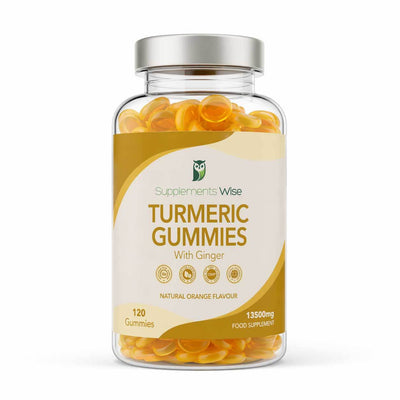
Turmeric and Ginger Gummies 120 Natural Orange Flavour
120 pectin gummies · 60-day supply at two a day
- 256.5 mg curcuminoids (95%) from a 50:1 turmeric extract per two-gummy serving
- 180 mg ginger equivalent from a 15:1 ginger extract in the same serving
- Natural orange flavour, no gelatin, no artificial colours
Vegan · 30-day returns · Free UK shipping
In this article
- Do turmeric and ginger actually work when taken together?
- What the evidence says about combined anti-inflammatory effects
- Can turmeric and ginger help with joint pain and osteoarthritis?
- How well does ginger work for nausea?
- Do turmeric and ginger help with digestion, IBS and bloating?
- What about menstrual cramps and period pain?
- Why does turmeric need black pepper or a smart formulation?
- How much turmeric and ginger should you actually take each day?
- What form is worth buying: gummies, capsules, tea or fresh root?
- What are the side effects and who should avoid turmeric and ginger?
- What claims about turmeric and ginger should you ignore?
- Frequently Asked Questions
Do turmeric and ginger actually work when taken together?
Both roots come from the same plant family (Zingiberaceae) and share overlapping anti-inflammatory pathways, which is why traditional Ayurvedic and Chinese medicine paired them for centuries. Modern lab work has shown that when curcumin (turmeric's main active compound) and shogaols (ginger's active compounds) are combined, they suppress inflammatory signalling more strongly than either alone.
The key 2022 paper (Zhou et al., Molecules, DOI: 10.3390/molecules27123877) used isolated immune cells and found a genuine synergistic effect at a 5:2 ginger-to-turmeric ratio, driven by activation of the Nrf2-HO-1 pathway. That laboratory synergy has not yet been proven in a large human trial, so the honest position is: the mechanism is real, the human proof for the combination specifically is still building.
Where the evidence is much cleaner is for each ingredient on its own. Turmeric extracts have moderate RCT evidence for knee osteoarthritis, and ginger has strong RCT evidence for several types of nausea. Taking them together is unlikely to hurt and may help slightly more than either alone.
What the Research Says
Zhou et al. (2022, DOI: 10.3390/molecules27123877) tested ginger and turmeric extracts on immune cells stimulated with bacterial toxin (LPS). The combination at a 5:2 ratio produced a synergistic suppression of pro-inflammatory nitric oxide, TNF-alpha and IL-6 (combination index below 1) that neither extract achieved alone, mediated through the Nrf2-HO-1 antioxidant pathway.
What the evidence says about combined anti-inflammatory effects
Chronic low-grade inflammation is a real driver of many age-related complaints, and both curcumin and ginger reduce inflammatory blood markers such as CRP, TNF-alpha and IL-6 in humans. A 2022 meta-analysis of curcumin trials found consistent CRP reductions across studies in overweight adults, and a smaller body of ginger trials shows similar direction of effect at 1 to 2 grams a day.
What this does not mean is that turmeric and ginger "cure" inflammation. They nudge the biomarkers in the right direction, and the effect is real but modest, comparable to a small improvement in diet or an extra weekly walk.
If you already eat oily fish, do some form of resistance exercise, and get your five a day, adding turmeric and ginger is a sensible topping-up move, not a rescue mission. See our full anti-inflammatory supplements UK evidence guide for how the pair sits alongside omega-3, magnesium and vitamin D.
Can turmeric and ginger help with joint pain and osteoarthritis?
Turmeric has the strongest evidence here. A 2016 meta-analysis of eight RCTs by Daily et al. (Journal of Medicinal Food, DOI: 10.1089/jmf.2016.3705) found that 1,000 mg a day of curcumin extract reduced pain and improved function in knee osteoarthritis to a degree comparable to ibuprofen, with far fewer stomach side effects.
Ginger adds a smaller but real effect on joint pain, backed by short RCTs in knee OA using 500 to 1,000 mg a day. Neither ingredient replaces a proper strength-and-mobility programme, and neither will help a torn meniscus or advanced bone-on-bone arthritis.
For a joint-support routine, the sensible pairing is a UK-made turmeric and ginger product for 8 to 12 weeks alongside walking, cycling or resistance work. If pain, swelling or morning stiffness persists past three months, ask your GP for a proper assessment rather than adding a third supplement.
How well does ginger work for nausea?
This is where ginger clearly outperforms turmeric. A 2014 meta-analysis by Viljoen et al. (Nutrition Journal, DOI: 10.1186/1475-2891-13-20) of 12 RCTs in 1,278 pregnant women found that ginger significantly reduced nausea versus placebo at doses of 500 to 1,500 mg a day, with a safety profile the authors described as reassuring.
Ginger also has decent RCT data for motion sickness, post-operative nausea and (with more mixed results) chemotherapy-induced nausea. Turmeric on its own has almost no useful nausea evidence, so if nausea is the main reason you are buying, ginger is doing the heavy lifting in a combination product.
Practical dose for occasional nausea: 250 to 500 mg of ginger extract 30 minutes before travel or a queasy meal. Pregnant users should speak to their midwife or GP first, especially in the first trimester, and see our pregnancy and postnatal supplements guide for a wider look.
Do turmeric and ginger help with digestion, IBS and bloating?
Both roots stimulate bile and enzyme secretion, which explains why they have been used as traditional digestive aids for centuries. In UK IBS trials, curcumin has shown modest improvements in pain and bloating over 8 weeks, and ginger has a similar direction of effect for functional dyspepsia (upper-abdomen fullness after meals).
The problem is that IBS symptoms are driven by many factors (fibre balance, FODMAPs, stress, sleep, gut microbes), so a turmeric and ginger tea or capsule is one small lever among several. It works best when paired with sensible fibre, hydration and stress management, not as a stand-alone fix.
For IBS specifically, see our IBS supplements UK evidence guide for how peppermint oil, probiotics and turmeric and ginger stack up against each other on trial data.
What about menstrual cramps and period pain?
Ginger has surprisingly good evidence for primary dysmenorrhoea (period pain not caused by an underlying condition). Small UK-relevant RCTs have shown 250 mg of ginger four times a day, started at the first sign of a period, reducing pain by an amount comparable to over-the-counter ibuprofen or mefenamic acid.
Curcumin's evidence for period pain is thinner but the two are often used together in real-world routines, and there is no safety reason not to combine them. If you have very heavy periods, pain that stops you working, or pain accompanied by bleeding between periods, please see your GP: dysmenorrhoea can be a symptom of endometriosis or fibroids that supplements will not fix.
A pragmatic protocol is two turmeric and ginger gummies or capsules daily in the week before your period, then adding a plain ginger tea or a second capsule at the first cramp. Warmth, magnesium and gentle movement remain the low-cost workhorses alongside.
Why does turmeric need black pepper or a smart formulation?
Curcumin is famously poorly absorbed. Shoba et al. (Planta Medica, 1998, DOI: 10.1055/s-2006-957450) showed in human volunteers that a 2-gram dose of plain curcumin barely raised blood levels, but adding just 20 mg of piperine (from black pepper) raised bioavailability by roughly 2,000 percent.
Modern formulations use one of three fixes: piperine, a phospholipid complex (Meriva), or a nano-particle formulation (Theracurmin). All three genuinely improve absorption; a plain 500 mg turmeric powder capsule with no absorption aid is largely a placebo.
Ginger does not have this problem: the shogaols and gingerols are absorbed reasonably well on their own. If you are choosing a combined product, look at what the turmeric fraction is doing about bioavailability before you look at price.
How much turmeric and ginger should you actually take each day?
The dose that turned up positive in most trials is 500 to 1,000 mg of a standardised turmeric extract (giving 250 to 500 mg curcuminoids) and 250 to 1,500 mg of ginger, taken with food. Higher does not appear to be much better and increases side-effect risk.
Split the dose morning and evening rather than taking it all at once, because absorption is limited by dose. If you are using it for a specific purpose (period cramps, motion sickness, post-workout stiffness) time the dose to about 30 to 60 minutes before you need the effect.
Give any turmeric and ginger routine 8 to 12 weeks before deciding whether it works for you: the anti-inflammatory effect on joints is gradual, and blood-marker changes take at least a month to appear.
| Reason to take | UK evidence grade | Sensible daily dose | Time to notice |
|---|---|---|---|
| Knee osteoarthritis pain | Moderate to good | 1,000 mg curcumin plus 500 to 1,000 mg ginger | 4 to 12 weeks |
| Pregnancy or motion sickness | Good (ginger only) | 500 to 1,500 mg ginger | 30 to 60 minutes |
| Period cramps | Moderate (ginger stronger) | 1,000 mg ginger plus 500 mg curcumin | 1 to 2 cycles |
| IBS-type bloating | Modest | 500 mg curcumin plus 500 mg ginger | 4 to 8 weeks |
| General inflammation markers | Modest | 500 mg curcumin plus 500 mg ginger | 6 to 12 weeks |
What form is worth buying: gummies, capsules, tea or fresh root?
Fresh root is the tastiest but the least predictable dose: a thumb of fresh ginger is roughly 60 to 100 mg of active compounds, and grated fresh turmeric delivers a tiny amount of poorly absorbed curcumin. Tea is pleasant and low-risk but delivers a fraction of a trial-relevant dose.
Capsules with a standardised curcumin extract plus piperine or a lipid carrier are the closest match to the trial evidence for joint pain and inflammation. Gummies are a good middle option if you struggle with capsules or want a routine you will actually stick to: the Supplements Wise turmeric and ginger gummies deliver 256.5 mg of curcuminoids and 180 mg-equivalent ginger in a pectin base, which sits between a cup of ginger tea and a full clinical-dose capsule stack.
If you already own a bottle of plain 500 mg turmeric powder capsules with no absorption enhancer, they are close to inert. Do not throw them away, but do not expect much either: pair them with fresh black pepper on food or add a piperine product alongside.
What are the side effects and who should avoid turmeric and ginger?
Both are food-grade at culinary doses and safe for most adults at supplement doses of up to 1,500 mg turmeric extract and 1,500 mg ginger a day. The most common side effects are mild: reflux, loose stools and a warm feeling in the stomach.
The UK Food Standards Agency and the Committee on Toxicity have flagged rare but serious liver reactions to high-dose curcumin supplements (mostly from products above 1,500 mg a day with enhanced absorption), and around 30 cases have been reported in the UK since 2018. Stop and see a GP if you get yellowing of the skin or eyes, dark urine, unexplained tiredness or upper-right abdominal pain.
Worth Knowing
Avoid or check with a doctor first if you take warfarin, apixaban, rivaroxaban, clopidogrel or another blood thinner (both roots can add to bleeding risk), have gallstones or bile-duct blockage (both stimulate bile flow), are due to have surgery in the next two weeks, are on immunosuppressants after a transplant, or have iron-deficiency anaemia (curcumin can bind iron and reduce absorption). Pregnancy: ginger up to about 1 gram a day is broadly considered safe under midwife supervision, but high-dose turmeric extracts are not.
What claims about turmeric and ginger should you ignore?
The marketing world has grown tired of saying "supports joint comfort" and moved on to claims that turmeric and ginger reverse cancer, cure Alzheimer's, dissolve arterial plaque, "detox" the liver and burn belly fat. None of these hold up to a proper clinical read.
The other claim to ignore is that turmeric and ginger are somehow interchangeable with prescription medication. If your GP has prescribed methotrexate, colchicine, an anti-emetic or a proton-pump inhibitor, keep taking it: turmeric and ginger are food supplements, not licensed treatments.
| Skip this claim | Try this instead |
|---|---|
| "Reverses arthritis" or "regrows cartilage" | Realistic pain and stiffness relief at 8 to 12 weeks alongside physio |
| "Detoxes the liver" or "flushes toxins" | Alcohol under 14 units a week and normal weight for a healthy liver |
| "Cures Alzheimer's" or "prevents dementia" | Sleep, hearing checks and a Mediterranean-style diet with regular exercise |
| "Melts belly fat" or "boosts metabolism" | A modest calorie deficit and strength training two or three times a week |
| Unstandardised turmeric powder capsules without piperine | A 95% curcuminoids extract with piperine, a lipid carrier or nano formulation |
Key Takeaway
Buy turmeric and ginger for what they can do: gradual joint-pain relief, gentler nausea, easier periods and a modest nudge on inflammation. Do not buy them for what marketers claim: they do not reverse arthritis, cure Alzheimer's, dissolve plaque or "detox" anything.
Frequently Asked Questions
Is it OK to take turmeric and ginger together every day?
Yes, for most healthy UK adults, a daily dose of up to 1,000 mg of a standardised turmeric extract and up to 1,500 mg of ginger is well tolerated. Take them with food and split the dose morning and evening to reduce reflux and improve absorption.
Does a turmeric and ginger gummy work as well as a capsule?
A well-formulated gummy with a 50:1 turmeric extract and standardised curcuminoids gets close to a mid-dose capsule and easily beats a plain turmeric powder capsule with no absorption enhancer. A gummy tends to lose out to a high-dose capsule with piperine or a phospholipid carrier if you are targeting the top end of the joint-pain trial range.
How long does turmeric and ginger take to work for joint pain?
Most trials show meaningful pain and stiffness improvements between weeks 4 and 12 at a curcumin dose of around 1,000 mg a day. If you notice nothing after 12 weeks at a proper dose, stop the supplement and ask your GP for a proper joint assessment.
Can I take turmeric and ginger with paracetamol or ibuprofen?
Paracetamol is fine to combine at normal doses. Ibuprofen and other NSAIDs are usually fine short-term but both can slightly raise bleeding risk, so check with a pharmacist if you are on high-dose NSAIDs or need them for weeks on end.
Is turmeric and ginger safe in pregnancy?
Ginger up to about 1 gram a day has good evidence for pregnancy-related nausea and is broadly considered safe under midwife supervision. High-dose turmeric extracts are not recommended in pregnancy, so stick to culinary amounts of turmeric and treat concentrated capsules as off the menu until after birth and breastfeeding.
Should I take turmeric and ginger on an empty stomach?
No, always with food. Curcumin absorbs better with a bit of fat in the meal, and both roots are more likely to cause reflux or a warm stomach on an empty gut.
Can turmeric and ginger interact with any medications?
Yes, notably blood thinners (warfarin, apixaban, rivaroxaban, clopidogrel), diabetes medications, iron tablets and drugs metabolised by CYP3A4 such as tacrolimus. Check with a pharmacist or GP before adding a daily dose if you are on prescription medication, and stop two weeks before any planned surgery.
Turmeric and ginger are not a miracle pair, but they are one of the better-supported traditional herbal combinations to have crossed into modern trials. Used sensibly, at trial-relevant doses, alongside sleep, movement and a decent diet, they can take the edge off joint pain, calm a queasy stomach and nudge inflammatory markers in the right direction.
Use them for those things, ignore the "detox" and "reverse ageing" claims, and give any new routine at least 8 to 12 weeks before deciding whether it belongs in your daily stack. If your symptoms persist or worsen, talk to your GP: supplements are supporting acts, not replacements for a proper diagnosis. Guidance from the NHS on complementary medicine and the UK Committee on Toxicity is a good starting point for further reading.
Start the sensible 12-week turmeric and ginger trial
One UK-made gummy, twice a day, with food. Give it three months alongside movement and better sleep, and see whether joints and belly feel any friendlier. UK GMP-certified · Vegan · 30-day returns · Free UK shipping.
Shop Turmeric and Ginger GummiesThis article is for information only and is not medical advice. Food supplements should not replace a varied diet or a healthy lifestyle. Speak to your GP or pharmacist before starting any new supplement, especially if you are pregnant, breastfeeding, taking medication or managing a health condition.