Turmeric for Dogs: Benefits, Research and How to Choose

Turmeric works for stiff and arthritic dogs when it is given as a standardised curcumin extract paired with black pepper (piperine), at a weight-based dose of 15 to 20 mg of curcuminoids per kilo of body weight, split across two meals.
Kitchen turmeric powder sprinkled on dinner does very little because raw powder is only 2 to 5 per cent curcumin and has no piperine to help it absorb, while piperine itself has been shown to raise curcumin absorption by up to 2,000 per cent (Shoba 1998, DOI: 10.1055/s-2006-957450) and the two published UK-relevant canine trials both used standardised extracts. Give it daily with food for 4 to 8 weeks before deciding whether it works for your dog, and pair it with weight control and gentle exercise for the biggest effect.
Roughly 20 per cent of UK dogs over the age of one have some degree of osteoarthritis, and searches for "turmeric for dogs" jump every winter as owners spot post-walk stiffness. This guide covers the vet evidence, the right format, the honest dose table, when a combined formula beats turmeric alone, and when the answer is a vet visit not a supplement.
Key Takeaway
For a fair trial, give a UK-made standardised turmeric extract with piperine at 15 to 20 mg of curcuminoids per kg of body weight daily, with food, split across two meals, for at least 4 to 8 weeks. Kitchen powder is too weak and too poorly absorbed. For senior or moderate-to-severe arthritis, a combined 7-ingredient joint formula will usually outperform turmeric on its own.
Turmeric for Dogs, 500mg with Black Pepper
Standardised turmeric extract at 500 mg with 5 mg piperine per capsule. Open onto food or give whole. Two size packs so you can price-match to body weight.
500 mg per cap · UK GMP · With black pepper for absorption · 30-day returns · Free UK shipping
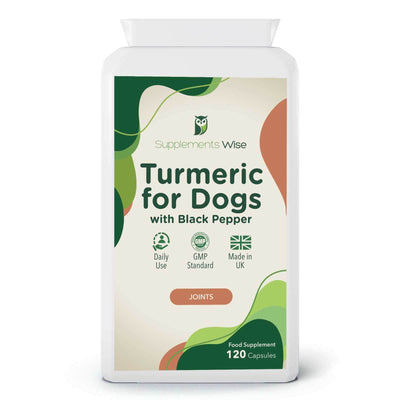
Starter pack · 12p per cap £13.95 |
BEST VALUE 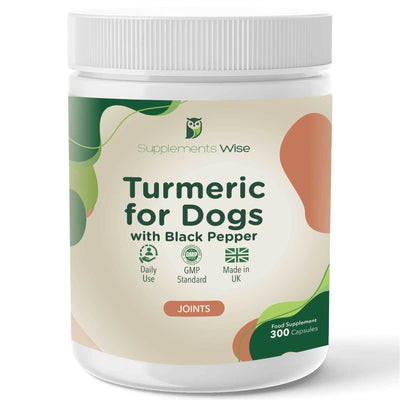
Value pack · 8p per cap £22.95 |
In this article
- What is turmeric and why does it help dogs?
- What does the veterinary research actually show?
- Why does curcumin need black pepper to work?
- How much turmeric should you give your dog?
- Powder vs golden paste vs capsules: which format wins?
- How does turmeric compare to glucosamine and green-lipped mussel?
- When does turmeric help most (and when does it not)?
- Which dogs should avoid turmeric?
- How long before you see a difference?
- How do you pick a quality UK turmeric supplement?
- Which product should you actually try first?
- Frequently asked questions
What is turmeric and why does it help dogs?
Turmeric is one of the most-bought natural supplements for dogs in the UK, mostly reached for to support stiff, ageing or working joints. It is the root of the Curcuma longa plant, the same spice used in curries, and its main active group is the curcuminoids. Curcumin is the most studied of these, making up about 2 to 5 per cent of raw turmeric root by weight.
Curcumin reduces inflammation by blocking two signalling proteins: NF-kB and COX-2. Those are the same pathways prescription anti-inflammatories such as meloxicam target, just via a different mechanism. In dogs, the practical result tends to look like easier mornings, smoother stair climbs, and longer happy walks in older or large-breed dogs with joint stiffness.
The commonest UK uses are arthritis support, post-walk recovery in working dogs, and general anti-inflammatory cover for seniors. None of that replaces a vet diagnosis, but turmeric sits in a sensible toolkit alongside diet, weight control and prescribed medicine when needed.
What does the veterinary research actually show?
The evidence is moderate and pointing in the right direction. Two published veterinary trials in dogs and several human meta-analyses for joint pain support the anti-inflammatory mechanism, though the sample sizes in the dog trials are still small.
Colitti et al (2012), published in BMC Veterinary Research (DOI: 10.1186/1746-6148-8-180), gave a curcumin-based supplement to dogs with osteoarthritis and saw significant reductions in inflammatory markers and improved comfort scores over 20 days. Innes et al (2003), in the Journal of Veterinary Pharmacology and Therapeutics (DOI: 10.1046/j.1365-2885.2003.00534.x), reported measurable falls in joint inflammation biomarkers in a curcumin-treated group.
What the Research Says
Daily JW, Yang M, Park S (2016). Efficacy of turmeric extracts and curcumin for alleviating the symptoms of joint arthritis: a systematic review and meta-analysis of randomized clinical trials. Journal of Medicinal Food, 19(8): 717 to 729. DOI: 10.1089/jmf.2016.3705. The pooled 8-RCT human analysis found curcumin extracts performed comparably to ibuprofen for joint pain with fewer gastrointestinal side effects. Veterinary trials use lower doses but show the same inflammatory-marker signal, which is why the mechanism translates across species.
For perspective, this is a moderate evidence base, not a magic bullet. Expect a useful add-on benefit, not a replacement for vet-prescribed medicine in moderate or severe arthritis. The Blue Cross arthritis in dogs guidance is a sensible companion read for anyone spotting new stiffness.
Why does curcumin need black pepper to work?
Owners often ask can dogs have turmeric and black pepper together, and the answer is yes: the small amount of piperine used to boost curcumin absorption is safe at these doses.
Curcumin has notoriously poor bioavailability on its own. Most of it is broken down in the liver and excreted before it reaches the bloodstream, which is why early trials that gave raw powder showed weak results.
The fix is piperine, the active in black pepper. A landmark study by Shoba et al (1998) in Planta Medica (DOI: 10.1055/s-2006-957450) showed that adding piperine raised curcumin absorption by up to 2,000 per cent in healthy adults. That is why every well-formulated turmeric supplement, including ours, pairs the extract with a small measured piperine dose rather than leaving it to a sprinkle from the spice rack.
Newer formats such as liposomal or phytosomal curcumin also boost absorption, but tend to cost three to five times more per gram of curcuminoids. For most UK dog owners, a standardised turmeric extract with piperine is the best balance of price, evidence and absorption.
How much turmeric should you give your dog?
The honest answer is that there is no single licensed canine dose, so evidence-led UK suppliers settle around 15 to 20 mg of curcuminoids per kilo of body weight per day, split into two meals. That translates to roughly the weight bands below for a standardised extract with piperine at 500 mg per capsule.
| Dog body weight | Standardised extract dose | Common breeds |
|---|---|---|
| Up to 10 kg | 1 capsule daily | Small breeds, terriers, mini schnauzers |
| 11 to 20 kg | 2 capsules daily | Cockers, beagles, springers |
| 21 to 30 kg | 3 capsules daily | Labradors, golden retrievers, collies |
| Over 30 kg | 4 capsules daily | Larger labs, GSDs, mastiffs, big mixes |
Split the daily dose across breakfast and dinner if you can, and always give it with food. Curcumin absorbs better in the presence of dietary fat, and the food layer also reduces the (small) chance of stomach upset in the first week.
Powder vs golden paste vs capsules: which format wins?
The three popular ways to give a dog turmeric look similar but deliver very different amounts of curcumin. Kitchen powder is the weakest, golden paste is in the middle, and a standardised capsule with piperine is the most reliable.
Kitchen turmeric powder
Sprinkling kitchen turmeric on your dog's dinner is mostly performative. The powder is around 2 to 5 per cent curcumin and has no piperine, so the actual dose reaching the bloodstream is tiny.
You could technically meet a clinical dose with roughly a teaspoon and a half of kitchen powder a day for a 20 kg dog, but the absorbed amount would still be small without added black pepper and fat. It is harmless, but it is not why dogs in the trials improved.
Golden paste
Golden paste is the homemade option, mixing turmeric powder with coconut oil and freshly ground black pepper. It does better than dry powder because the fat and piperine both help absorption.
The downsides are dose variability from batch to batch, oxidation after a few days in the fridge, and the need to nail the pepper-to-turmeric ratio. It works best for owners who already home-cook and are happy to measure.
Standardised capsules with piperine
Capsules give you the most consistent dose. A purpose-made turmeric supplement for dogs delivers a measured curcuminoid dose with a fixed piperine ratio in every capsule, removing the guesswork of paste batches.
For most UK owners, that consistency is what makes the supplement worth the price difference over kitchen powder. Open the capsule onto food if your dog will not swallow it whole.
How does turmeric compare to glucosamine and green-lipped mussel?
Joint supplements work on different parts of the same problem. Turmeric reduces inflammation, glucosamine and collagen rebuild cartilage, green-lipped mussel does a bit of both, and omega-3 supports the joint capsule and brain in parallel.
| Ingredient | What it does | Best for |
|---|---|---|
| Turmeric (curcumin + piperine) | Reduces inflammation via NF-kB and COX-2 | Stiffness, swelling, post-exercise recovery |
| Glucosamine + chondroitin | Provides building blocks for cartilage repair | Long-term joint maintenance, slow build |
| Green-lipped mussel | Anti-inflammatory plus structural support | All-rounder when you want one supplement |
| MSM | Sulphur source for collagen and joint tissue | Pairs well with glucosamine |
| Omega-3 (EPA + DHA) | Modulates joint inflammation and brain health | Senior dogs, picky eaters, low-oily-fish diets |
| Collagen peptides | Hydrolysed amino acids for cartilage and skin | Older or post-surgery dogs |
For mild stiffness, turmeric on its own is a reasonable trial, but for a senior or arthritic dog a combined formula such as our Dog Joint Support 7-ingredient tablets gives turmeric plus glucosamine, green-lipped mussel, MSM, collagen and hyaluronic acid in one tablet. Our guide to the best joint supplements for dogs walks through how to choose between single ingredients and combined formulas. If you want the green-lipped mussel side on its own, Green Lipped Mussel capsules are the standalone option.
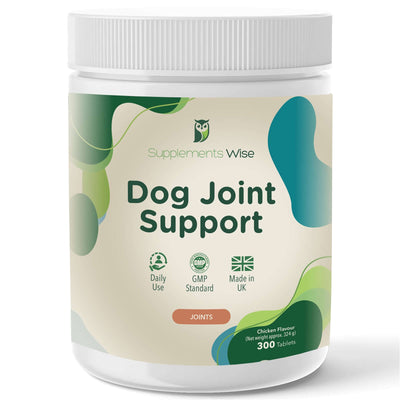
Dog Joint Support, 7 Ingredients with Collagen, 300 Tablets
Turmeric plus glucosamine, green-lipped mussel, MSM, hyaluronic acid, hydrolysed collagen and manganese in one tablet. The combined formula for arthritic or senior dogs.
UK GMP-certified · For dogs · 30-day returns · Free UK shipping
£34.95
Add to CartWhen does turmeric help most (and when does it not)?
Turmeric works best for low-grade chronic inflammation, which is exactly what age-related osteoarthritis is. Owners typically report easier movement, less morning stiffness, or quicker recovery from long walks by the 4 to 8 week mark.
It does not work as a painkiller in the moment. If your dog is limping, refusing food, vocalising in pain, or has had a sudden onset of stiffness, that is a vet visit and probably a prescribed anti-inflammatory, not a turmeric capsule.
It will also not treat infections, immune-mediated joint disease, hip-dysplasia surgery recovery, or cancer-related joint pain. Those are medical situations where turmeric might support, but never substitute, your vet's plan. For a wider look at daily basics, see our guide to what supplements your dog actually needs.
Which dogs should avoid turmeric?
Turmeric is widely tolerated at sensible doses. The commonest side effect is mild digestive upset (loose stools or reduced appetite) for the first week, which usually settles if you start at half the target dose and build up over 5 to 7 days.
Worth Knowing
Ask your vet before starting turmeric if your dog is on blood-thinning medication (turmeric mildly affects clotting), has gallbladder disease or gallstones, is on diabetes medication, is pregnant or lactating, or is booked for surgery in the next 2 weeks. Stop turmeric 5 to 7 days before any planned operation.
Turmeric is non-toxic at the doses used in supplements, but very high amounts of kitchen turmeric over a long period can cause GI upset and theoretically contribute to oxalate-related stone risk. Stick to a measured supplement dose and you will not run into that problem.
How long before you see a difference?
Most owners notice the first changes between weeks 2 and 4, with a more solid result at 6 to 8 weeks. Curcumin reduces inflammation gradually rather than acting like a painkiller, so daily consistency matters more than dose tweaks.
If you have seen nothing at all after 8 weeks of consistent daily dosing, it is fair to call it. Either turmeric is not enough on its own for that dog, or the joint problem is not primarily inflammatory and needs a different approach.
For the change to last, you need to keep giving it. Stopping for 2 weeks typically undoes most of the benefit, because the anti-inflammatory effect depends on a steady curcumin level in the body.
How do you pick a quality UK turmeric supplement?
Read the label, not the marketing claims. A well-made canine turmeric supplement should be a standardised extract (not just dried root powder), should declare the curcuminoid content, should include piperine or black pepper extract, and should give a weight-based dose chart.
UK-made and manufactured to GMP standards is a sensible default for both quality and traceability. Be sceptical of dog-and-human "golden paste" jars sold without dosing guidance, very cheap kitchen-grade products marketed for pets, and any product that lists turmeric alongside a long list of fillers without specifying ingredient amounts.
If your dog refuses tablets or you already give a lot of pills, our chicken-flavour Dog Joint Support Powder mixes straight into food. If you prefer a single-ingredient standalone, capsules remain the cleanest format.

Dog Joint Support Powder, 150g Chicken Flavour
Same 7-ingredient joint blend as the tablets, in a scoop-and-sprinkle chicken-flavoured powder. For dogs who refuse pills or already take a lot of them.
UK GMP-certified · For dogs · 30-day returns · Free UK shipping
£19.95
Add to CartWhich product should you actually try first?
The quickest way to decide is to match the product to what your dog actually needs. The table below maps the common cases to a sensible first move.
| Loudest issue | Start here | Daily dose | Review at |
|---|---|---|---|
| Mild post-walk stiffness in a young or middle-aged dog | Turmeric for Dogs capsules | 15 to 20 mg curcuminoid per kg | 4 to 8 weeks |
| Senior dog with confirmed arthritis | Dog Joint Support 300 tablets | 1 to 3 tablets by weight | 6 to 8 weeks |
| Dog who refuses pills | Dog Joint Support Powder | Scoop by weight into food | 6 to 8 weeks |
| Owner wants a single-ingredient trial | Green Lipped Mussel capsules | ~77 mg per kg body weight | 4 to 6 weeks |
Key Takeaway
Pick a UK-made standardised turmeric extract with piperine, dose to body weight, give it with food for 8 weeks, and combine with weight management and gentle daily exercise. For senior or arthritic dogs, a 7-ingredient joint formula will usually outperform turmeric on its own.
Frequently asked questions
Can dogs have turmeric every day?
Yes, daily use is how turmeric is designed to work for dogs. Curcumin reduces inflammation gradually, so consistent daily dosing for 4 to 8 weeks gives the fairest trial. Always give it with food and split into two meals when possible.
What dose of turmeric is safe for dogs?
Most evidence-led UK supplements use 15 to 20 mg of curcuminoids per kg of body weight daily, split across meals. As a practical guide, that is 1 capsule of a 500 mg standardised extract for dogs up to 10 kg, scaling up to 4 capsules for dogs over 30 kg. Always follow the product label and check with your vet for dogs on medication.
Why does turmeric need black pepper for dogs?
Curcumin on its own has very poor bioavailability and most of it is broken down before reaching the bloodstream. Piperine, the active in black pepper, has been shown to increase curcumin absorption by up to 2,000 per cent. A well-formulated turmeric supplement for dogs always pairs the extract with a small piperine dose.
Can I give my dog kitchen turmeric powder?
It is safe in small amounts but the dose is too low to do much. Kitchen turmeric is only about 2 to 5 per cent curcumin and contains no piperine, so very little reaches your dog's joints. A standardised extract with black pepper is the format used in the studies showing clinical benefit.
How long does turmeric take to work in dogs?
Most owners notice the first changes between weeks 2 and 4, with clearer results at 6 to 8 weeks. Turmeric is anti-inflammatory rather than a painkiller, so daily consistency matters more than dose tweaks. If you see nothing at all after 8 weeks, it is fair to try a combined joint formula instead.
Is turmeric safe with other joint supplements?
Yes, turmeric pairs well with glucosamine, chondroitin, green-lipped mussel, MSM and omega-3 because each works through a different pathway. Many combined canine joint formulas already include turmeric alongside structural ingredients. Avoid stacking multiple turmeric products on top of each other, because curcumin doses add up.
Which dogs should not take turmeric?
Speak to your vet first if your dog is on blood thinners, has gallbladder disease or gallstones, is on diabetes medication, is pregnant or lactating, or is booked for surgery in the next two weeks. Healthy adult dogs without those flags tolerate sensible doses very well.
Turmeric is a genuine anti-inflammatory tool for dogs, not a miracle cure. Give it a fair 4 to 8 week trial at the right dose, in the right format, alongside diet and weight control, and you will get the honest read on whether it works for your dog.
Start the sensible 8-week turmeric trial
Standardised 500 mg turmeric extract with piperine, dosed to body weight, made in the UK to GMP standards. From 8p per capsule on the 300 pack, with the 120 pack for a shorter trial first.
Shop Turmeric for DogsUK GMP-certified · For dogs · 30-day returns · Free UK shipping
Prefer to browse the wider selection first? Every SW canine joint SKU sits in the dog joint supplements collection.
This article is for information only and is not medical advice. Food supplements should not replace a varied diet or a healthy lifestyle. Speak to your GP or pharmacist before starting any new supplement, especially if you are pregnant, breastfeeding, taking medication or managing a health condition.